
But is tokenization right for every enterprise? What are the benefits, risks, and practical considerations involved? This comprehensive guide explores what enterprises need to know about tokenizing assets, helping decision-makers evaluate whether now is the time to embrace this transformative technology.
Understanding Asset Tokenization: The Basics
At its core, asset tokenization is the process of converting the ownership rights of a real-world or digital asset into a digital token, which is recorded on a blockchain. Think of it as creating digital certificates of ownership that can be easily traded, divided, and verified.
Consider these practical examples: a real estate developer can tokenize a property into 1,000 digital shares, allowing multiple investors to own fractional stakes. An art gallery can tokenize a valuable painting, democratizing access to high-value investments. A corporation can tokenize bonds or securities for more efficient trading and settlement.
Each token represents a claim to part of the underlying asset, while the blockchain ensures transparency, immutability, and seamless transferability. This creates a new paradigm for asset ownership and trading that bridges traditional finance with digital innovation.
Types of Assets That Can Be Tokenized
The scope of tokenization extends across virtually every asset class, opening new possibilities for enterprises in diverse industries.
- Real Estate Tokenization enables commercial and residential properties to be fractionalized, dramatically improving liquidity and opening access to smaller investors who were previously excluded from premium real estate markets.
- Equities and Securities can be tokenized to enable faster settlement times and broader investor participation. Private company shares, bonds, and investment funds become more accessible and tradable when converted to digital tokens.
- Commodities Tokenization applies to physical assets like gold, oil, and agricultural products, enabling transparent supply chain tracking and more efficient trading mechanisms that reduce intermediary costs.
- Intellectual Property, including patents, music rights, and digital art through NFTs, can be tokenized to ensure proof of ownership and automated royalty distribution, giving creators more control and transparency.
- Supply Chain Assets, such as shipping containers, invoices, and logistics data, can be tokenized to improve operational efficiency, enhance traceability, and reduce fraud across complex supply networks.
Why Leading Enterprises Are Embracing Tokenization
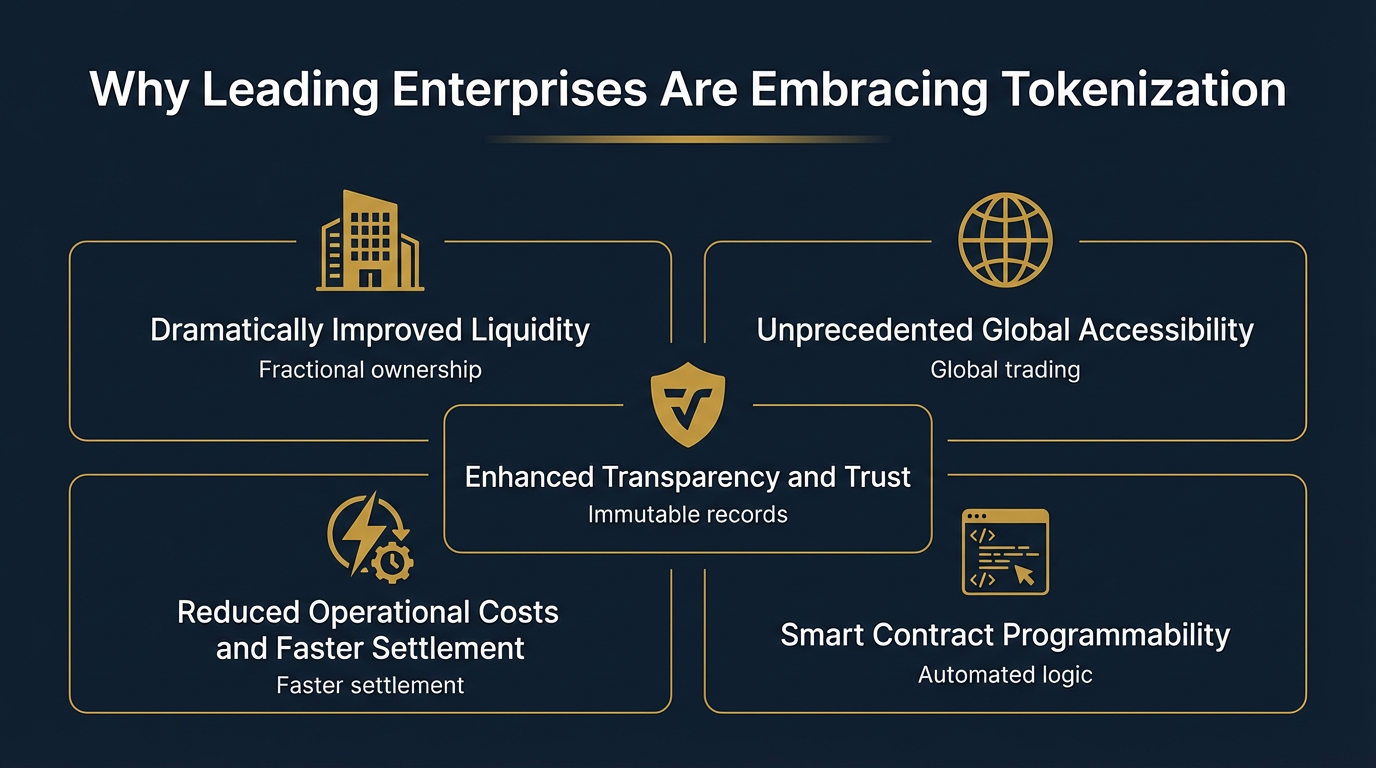
Tokenization isn't simply blockchain hype—it delivers measurable business value. Forward-thinking enterprises are leveraging tokenization for strategic advantages that directly impact their bottom line.
Dramatically Improved Liquidity
Traditional assets like real estate, private equity, and fine art have historically been extremely illiquid. Tokenization fundamentally changes this by enabling fractional ownership, allowing investors to buy and sell smaller portions on secondary markets. This liquidity premium can significantly increase asset valuations while attracting a broader investor base.
Unprecedented Global Accessibility
Blockchain technology operates continuously across borders, giving enterprises immediate access to a global pool of investors and trading partners. Geographic barriers that once limited capital formation are eliminated, enabling 24/7 trading and settlement.
Enhanced Transparency and Trust
Every transaction is immutably recorded on the blockchain, creating an auditable trail that reduces fraud risk and increases stakeholder confidence. This transparency is particularly valuable in industries where provenance and authenticity are critical concerns.
Reduced Operational Costs and Faster Settlement
Tokenized assets can be traded peer-to-peer without traditional intermediaries like brokers and clearinghouses. This disintermediation significantly reduces transaction fees while accelerating settlement from days to minutes or seconds.
Smart Contract Programmability
Perhaps most powerfully, tokenization enables embedding business logic directly into assets through smart contracts. Dividends, royalties, compliance rules, and transfer restrictions can be automated, reducing administrative overhead and eliminating manual errors.
Critical Challenges Enterprises Must Navigate
While tokenization offers compelling benefits, enterprises must carefully evaluate significant challenges before committing resources.
Regulatory Complexity and Uncertainty
The regulatory landscape for tokenized assets remains fragmented and evolving. Tokenized securities typically fall under existing financial regulations, including SEC oversight in the United States and the MiCA framework in the European Union. Enterprises must ensure strict compliance with anti-money laundering requirements and know-your-customer protocols, which can be complex when operating across multiple jurisdictions.
Technology and Security Risks
Smart contract vulnerabilities represent a serious concern, as coding errors can lead to exploits and loss of assets. Professional security audits are essential to identify and fix potential security flaws. Additionally, blockchain scalability limitations may impact transaction costs and processing speed, particularly during periods of network congestion. Enterprises need robust security audits and contingency planning.
Market Adoption and Liquidity Considerations
Tokenized asset markets are still maturing, and actual liquidity depends heavily on active investor participation. Secondary trading platforms remain limited compared to established traditional exchanges, potentially constraining the liquidity benefits that make tokenization attractive in the first place.
Operational Integration Complexity
Integrating blockchain systems with existing enterprise infrastructure presents technical and organizational challenges. Managing custody of digital tokens and private keys requires implementing new processes, security protocols, and employee training programs that differ significantly from traditional asset management.
Web2 vs Web3: Understanding the Paradigm Shift
Traditional Web2 systems rely on centralized databases, custodians, and brokers controlling access and transactions. In contrast, Web3 tokenization leverages blockchain, decentralized finance protocols, and smart contracts to create peer-to-peer asset networks.
Where Web2 assets have ownership recorded in centralized ledgers controlled by institutions, Web3 tokenized assets provide ownership verified directly on the blockchain through cryptographic tokens. Web2 liquidity remains limited and dependent on intermediary brokers, while Web3 enables high liquidity through fractionalization and continuous trading. Transparency in Web2 systems is opaque and controlled by custodians, whereas Web3 provides immutable and publicly verifiable on-chain records. Finally, Web2 settlement takes days through clearing processes, but Web3 enables near-instant settlement via automated smart contracts.
Real-World Enterprise Use Cases for Tokenization
Transforming Real Estate Investment
Real estate enterprises are tokenizing properties to reduce investment barriers and improve capital formation. For instance, a commercial property valued at $20 million could be divided into 20,000 tokens, each representing $1,000 of ownership. This fractionalization allows retail investors to participate in commercial real estate deals previously accessible only to institutional players.
Revolutionizing Financial Services
Financial institutions are tokenizing bonds, securities, and structured products to accelerate trading and dramatically reduce back-office operational costs. Major banks like JPMorgan have successfully experimented with blockchain-based tokenized debt instruments, demonstrating the viability of this approach at enterprise scale.
Enhancing Supply Chain Transparency
Manufacturing and logistics companies are tokenizing raw materials and goods to provide unprecedented visibility into provenance and ethical sourcing. Tokenized gold, for example, ensures buyers can verify exactly where and when gold was mined, addressing concerns about conflict minerals and environmental impact.
Empowering Media and Entertainment
Entertainment companies are tokenizing music royalties and content rights to ensure artists and creators receive transparent, automated payments. A music company could tokenize streaming revenue rights, allowing fans and investors to participate directly in an artist's success while ensuring fair compensation through smart contracts.
Strategic Steps for Enterprise Tokenization Success
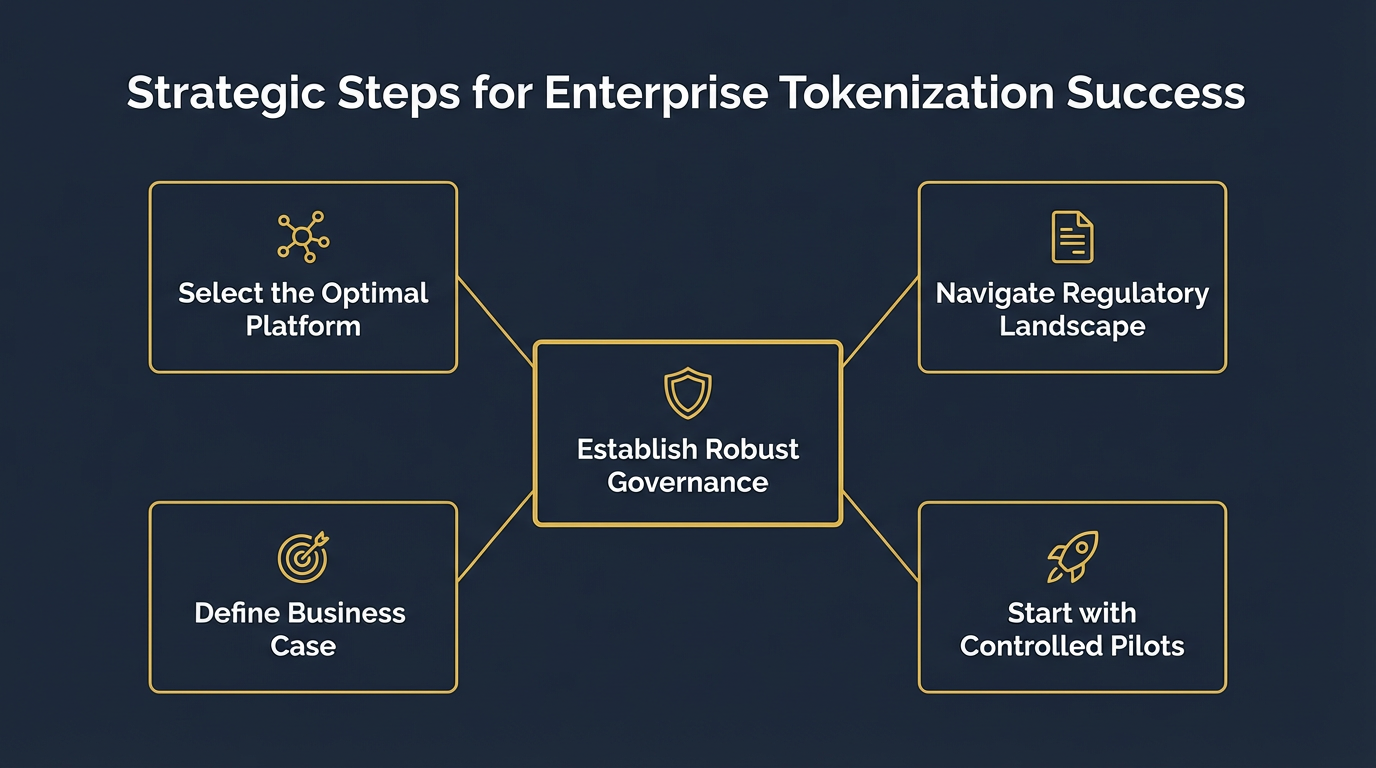
Define a Clear Business Case
Before pursuing tokenization, enterprises must rigorously evaluate whether it solves a genuine business problem. Does your organization struggle with asset illiquidity, lack of transparency, or excessive transaction costs? Can you articulate a clear return on investment that justifies the implementation effort and ongoing maintenance costs?
Navigate the Regulatory Landscape
Engage legal experts specializing in blockchain and securities law early in your planning process. Ensure comprehensive compliance with securities regulations, understand tax implications across relevant jurisdictions, and address data privacy requirements. Regulatory compliance isn't optional—it's foundational to sustainable tokenization strategies.
Select the Optimal Blockchain Platform
Choose between public blockchains like Ethereum, Polygon, and Solana versus private or permissioned networks such as Hyperledger and Corda. Your decision should consider scalability requirements, transaction cost tolerance, security needs, and ecosystem maturity. Each platform offers different tradeoffs between decentralization, performance, and control.
Establish Robust Governance Models
Define clear governance structures specifying who manages tokens, validates transactions, and updates smart contract rules. For multi-party ecosystems, establish consortium frameworks with transparent decision-making processes. Governance failures are among the most common causes of tokenization project difficulties.
Implement Enterprise-Grade Security
Conduct thorough smart contract audits using reputable security firms before deployment. Choose institutional-grade custody solutions for token storage that provide insurance, regulatory compliance, and disaster recovery capabilities. Security cannot be an afterthought in tokenization initiatives.
Start with Controlled Pilots
Launch limited tokenization pilots before committing to full-scale deployment. Pilot projects allow you to collect stakeholder feedback, identify unexpected challenges, refine your operational model, and build organizational capability before significant resource allocation.
How Blockchain Consultants Accelerate Tokenization Success
For most enterprises, tokenization represents uncharted territory requiring specialized expertise. Experienced blockchain consultants provide critical value by assessing technical and business feasibility, ensuring alignment between tokenization initiatives and broader strategic goals.
These experts design robust technical architectures and develop secure smart contracts tailored to specific business requirements. They navigate complex regulatory frameworks, ensuring compliance across relevant jurisdictions while managing risk. Consultants also guide pilot programs and oversee production deployment, transferring knowledge to internal teams and establishing sustainable operational models.
The Future of Tokenized Economies
Industry analysts predict that asset tokenization could unlock trillions of dollars in previously illiquid value over the next decade. Boston Consulting Group's 2023 research estimates that approximately $16 trillion worth of assets could be tokenized by 2030, representing a fundamental transformation in how value is stored and exchanged.
Several key trends will shape the tokenization landscape. Integration with decentralized finance (DeFi) platforms will enable tokenized assets to be traded on decentralized exchanges and used as collateral for lending. Central Bank Digital Currencies will complement tokenized securities and commodities, creating seamless digital value ecosystems. Improved blockchain interoperability will allow assets to move freely across different networks, reducing fragmentation. Perhaps most importantly, regulatory clarity will emerge as governments worldwide develop comprehensive frameworks that drive mainstream adoption.
Making the Tokenization Decision
Asset tokenization has genuine potential to revolutionize how enterprises manage, trade, and derive value from assets. The benefits—enhanced liquidity, reduced costs, improved transparency, and global accessibility—are compelling and increasingly proven by real-world implementations.
However, challenges around regulatory compliance, technology maturity, and market adoption mean enterprises must proceed thoughtfully and strategically. Not every asset needs to be tokenized, and not every organization is ready for this transformation.
The critical insight is this: for industries plagued by illiquidity, operational inefficiency, or lack of transparency, tokenization can provide a powerful competitive advantage. Companies that explore tokenization strategically—starting with focused pilots, ensuring rigorous compliance, building secure technical systems, and learning iteratively—will be best positioned to capitalize on the emerging tokenized economy.
The question isn't whether tokenization will reshape enterprise asset management, but rather which enterprises will lead this transformation and which will be forced to follow. By understanding both the opportunities and challenges, your organization can make informed decisions about when and how to embrace this powerful technology.
Ready to explore asset tokenization for your enterprise? Contact our blockchain experts to discuss how tokenization can unlock value in your business. Learn more about our enterprise blockchain solutions and blockchain development trends shaping the future.