
Launching a blockchain project isn't just about writing smart contracts or spinning up a token. The real challenge lies in moving from a small proof-of-concept (POC) or pilot project into a production-ready solution that can scale, comply with regulations, and deliver real-world business value.
This journey is rarely straightforward. Blockchain is still a fast-evolving space with unique complexities around technology, governance, and adoption. That's why many enterprises and startups turn to blockchain consultants—specialized experts who help navigate the transition from pilot to production.
In this guide, we'll explore the critical role blockchain consultants play, the hurdles they help organizations overcome, and a step-by-step roadmap for making blockchain projects production-ready.
Why Blockchain Projects Struggle Beyond the Pilot Stage
The idea of using blockchain often starts with excitement—transparent supply chains, secure cross-border payments, decentralized identity, or tamper-proof data. Many organizations successfully launch pilots to showcase potential benefits. Yet, studies show that a large percentage of blockchain initiatives never make it past the pilot phase.
The path from pilot to production is fraught with challenges that weren't apparent in the initial testing phase. Scalability limitations present the first major hurdle, as what works smoothly with 100 test transactions may completely fail when faced with 100,000 real-world transactions. Integration issues compound these problems since blockchain systems rarely exist in isolation—they need to work seamlessly with legacy systems, existing APIs, and various external data sources.
Governance challenges often prove to be the most complex obstacle, particularly in multi-party projects. Organizations struggle with fundamental questions about who controls the network and how decisions are made. Meanwhile, regulatory uncertainty creates a constantly shifting landscape as compliance with financial regulations, privacy laws, and data protection requirements continues to evolve.
Perhaps most critically, many pilots demonstrate technical feasibility but fail to align with genuine business needs. Without clear business value and stakeholder buy-in, even technically sound projects struggle to justify the resources required for production deployment.
This is where blockchain consultants become invaluable guides.
The Role of Blockchain Consultants
Blockchain consultants act as strategic partners who combine technical expertise, industry knowledge, and business acumen. Their job isn't just coding—it's helping clients make blockchain solutions sustainable, compliant, and scalable.
These specialists begin with a strategic assessment, carefully evaluating whether blockchain is actually the right fit for the specific business problem at hand. Not every use case truly benefits from decentralization, and experienced consultants can save organizations from costly mistakes by identifying when traditional solutions might be more appropriate.
When blockchain does make sense, consultants guide architecture design decisions that will determine the project's long-term success. This involves choosing the right blockchain platform from options like Ethereum, Hyperledger, Corda, Solana, or Polygon, along with selecting appropriate consensus mechanisms and designing overall system architecture.
During the pilot development phase, consultants build and test small-scale proof-of-concepts that demonstrate feasibility while identifying potential issues before they become expensive production problems. They then focus on scalability planning, designing solutions that can handle growth in users, transactions, and data without breaking down under real-world pressure.
Regulatory and compliance guidance represents another crucial area where consultants provide value. They help organizations navigate complex legal frameworks including GDPR, AML requirements, KYC protocols, SEC regulations, and data residency laws that vary by jurisdiction.
Change management and governance support helps align diverse stakeholders, establish clear rules for network participation, and manage the organizational transformation that blockchain adoption typically requires. Finally, consultants assist with deployment and maintenance, helping organizations transition from testing environments to live deployment while establishing proper DevOps practices, monitoring systems, and upgrade procedures.
From Pilot to Production: Step-by-Step Roadma
Let's walk through the typical phases that blockchain consultants guide organizations through on their journey from concept to production.
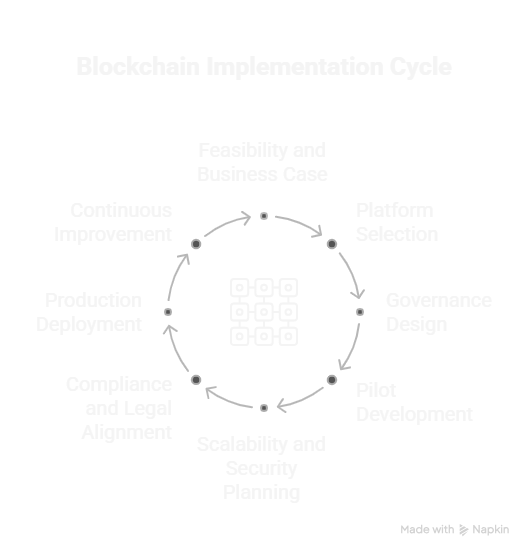
1. Feasibility and Business Case
The first step involves clarifying the fundamental question: why blockchain? Consultants conduct thorough assessments to determine whether decentralization offers real advantages over traditional database solutions.
This process begins with identifying specific pain points such as fraud, operational inefficiency, or lack of trust between parties. Consultants then evaluate whether blockchain's unique characteristics actually address these issues better than existing alternatives. They work with stakeholders to estimate potential return on investment and establish realistic expectations for long-term value creation.
2. Choosing the Right Platform
Not all blockchains are created equal, and the platform selection decision will impact every aspect of the project's future development. Consultants help organizations evaluate the tradeoffs between public chains like Ethereum and private solutions like Hyperledger Fabric.
The decision process considers transaction throughput requirements, which vary dramatically between use cases like high-frequency financial trading versus supply chain tracking. Ecosystem support and available tooling also play crucial roles, as Ethereum offers the largest developer ecosystem while Hyperledger provides enterprise-focused features that many organizations require.
3. Designing Governance Models
Governance design often gets overlooked in the excitement of technical development, but it's critical for long-term success. Consultants help organizations define fundamental operational questions: who will run the network nodes, how will system upgrades be proposed and approved, and what incentives will keep participants engaged over time?
Multi-stakeholder projects like supply chain consortia face particularly complex governance challenges that require careful balance between competing interests. Clear governance frameworks established early in the process prevent conflicts that could derail production deployment.
4. Pilot Development
During this crucial phase, consultants build a minimal viable product or focused pilot with the goal of proving feasibility rather than achieving full scale. The development work includes smart contract coding and comprehensive testing, integration with existing organizational systems, and demonstration of clear business value within a carefully defined scope.
Successful pilots provide concrete evidence that the blockchain approach can work while revealing potential issues that need addressing before production deployment. This phase often uncovers integration challenges, performance limitations, or user experience issues that weren't apparent in initial planning.
5. Scalability and Security Planning
Moving to production requires addressing performance requirements that pilot projects typically don't face. Consultants must ensure the system can handle anticipated real-world transaction volumes without degrading performance or user experience.
Security considerations become paramount at this stage, including comprehensive smart contract audits to prevent vulnerabilities that could be exploited by malicious actors. Data management strategies must address the challenges of handling large-scale storage while making informed decisions about what information belongs on-chain versus off-chain storage solutions.
6. Compliance and Legal Alignment
Consultants work closely with legal teams to ensure production systems meet all applicable regulatory requirements. This involves navigating data privacy laws like GDPR and HIPAA, financial regulations including AML and KYC requirements, and complex questions around token classifications that determine whether digital assets are considered utilities or securities.
The regulatory landscape continues evolving rapidly, making experienced guidance essential for avoiding costly compliance failures that could shut down production systems.
7. Production Deployment
This critical phase involves transitioning from test environments to live systems serving real users and processing actual transactions. Consultants guide the implementation of DevOps practices and continuous deployment pipelines that enable reliable system updates without service interruptions.
Comprehensive monitoring tools and analytics systems provide visibility into system performance and user behavior, while carefully designed user onboarding processes and training programs ensure successful adoption by both technical and non-technical stakeholders.
8. Continuous Improvement and Governance Evolution
Once live, blockchain solutions require ongoing attention and evolution. Consultants help organizations adapt as transaction volumes grow, new regulations emerge, and network participant requirements change over time.
This ongoing relationship ensures that blockchain implementations remain effective and compliant as business needs evolve and new technologies become available.
Real-World Example: Supply Chain Blockchain
Consider a multinational retailer exploring blockchain for product traceability. During the pilot phase, consultants help build a focused proof-of-concept tracking produce from a single farm to one distribution center. This limited scope allows for testing core functionality while identifying potential challenges.
However, scaling to production reveals significant complexity. The system must now handle thousands of suppliers across multiple countries, ensure data quality from diverse sources with varying technical capabilities, and comply with international trade regulations that differ by jurisdiction.
The production solution requires consultants to design a consortium blockchain that balances the interests of multiple stakeholders, integrates IoT devices for automated data collection, establishes clear governance rules for network participation, and builds comprehensive dashboards that serve both internal operations and external regulators.
This example illustrates how blockchain consultants bridge the gap between initial vision and operational reality, addressing challenges that only become apparent when moving from controlled pilot environments to complex production scenarios.
Challenges Consultants Help Solve
Technology complexity represents one of the most significant obstacles organizations face. Issues include achieving interoperability across different blockchain networks, managing the relationship between on-chain and off-chain data, and integrating with existing enterprise systems that weren't designed for blockchain interaction.
Stakeholder alignment challenges require careful navigation of competing interests and incentives among multiple parties while establishing trust mechanisms within systems specifically designed to operate without traditional trust relationships. This paradox often creates unexpected organizational challenges that require both technical and diplomatic solutions.
The rapidly evolving nature of blockchain standards means consultants must continuously update their knowledge and help clients integrate new scaling solutions like rollups or sidechains as they mature. User adoption challenges require designing intuitive interfaces that hide blockchain complexity from end users while providing comprehensive education for stakeholders who need to understand the system's benefits and limitations.
The Future of Blockchain Consulting
As blockchain adoption matures across industries, the consulting landscape continues evolving in response to new challenges and opportunities. Interoperability has emerged as a key focus area, with consultants helping clients connect across multiple blockchain networks to leverage the strengths of different platforms.
Integration with complementary technologies like artificial intelligence and Internet of Things devices creates new possibilities for cross-technology solutions that solve complex business problems. Regulatory advisory services become increasingly essential as governments worldwide continue to formalize cryptocurrency and blockchain legislation.
Sustainability blockchain consulting represents an emerging specialization as organizations seek energy-efficient blockchain platforms that align with corporate environmental commitments. Consultants in this space help organizations balance performance requirements with sustainability goals.
Looking ahead, blockchain consultants will evolve beyond technical guides to become strategic partners actively shaping digital transformation initiatives across industries.
Final Thoughts
Transitioning a blockchain project from pilot to production is a complex journey filled with technical, regulatory, and organizational challenges. Blockchain consultants play a pivotal role in guiding organizations through this uncertainty, ensuring that solutions are scalable, compliant, and aligned with genuine business needs.
For businesses considering blockchain adoption, the key insight is clear: don't focus exclusively on impressive pilot demonstrations. Real value emerges from sustainable production deployments that solve actual business problems while meeting regulatory requirements and user needs.
For consultants, the ongoing challenge involves staying ahead of rapid technological change while effectively balancing the diverse needs and expectations of multiple stakeholders. Success requires combining deep technical expertise with strong business acumen and excellent communication skills.
By bridging the gap between blockchain's transformative potential and practical execution requirements, skilled consultants ensure that blockchain technology moves beyond hype to become a trusted and valuable component of modern enterprise infrastructure.