
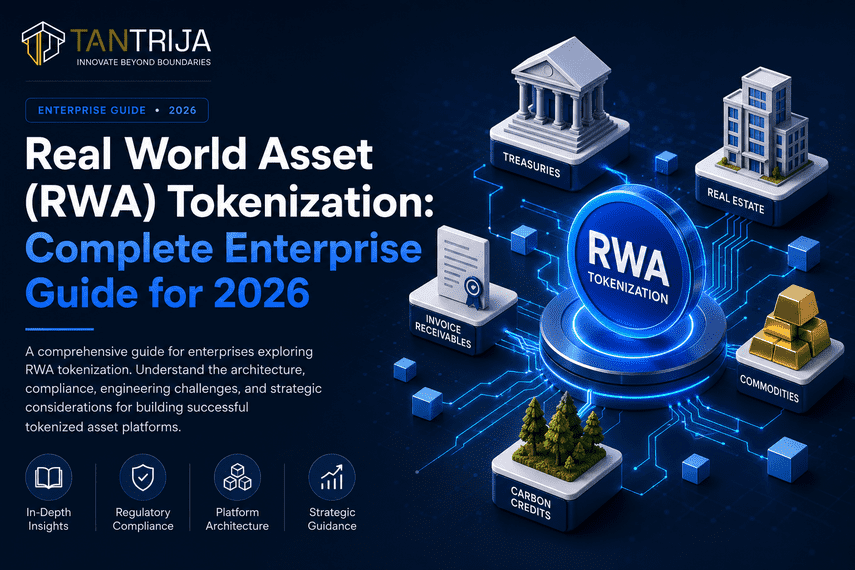
Real-world asset tokenization has shifted from speculative thesis to operating reality. By the start of 2026, on-chain tokenized treasuries had crossed $8 billion in value, tokenized money market funds from BlackRock, Franklin Templeton, and WisdomTree had become mainstream institutional products, and dozens of jurisdictions had passed or finalized RWA-specific regulatory frameworks.
For enterprises evaluating whether and how to tokenize their assets, the question has moved from "is this worth doing?" to "how do we do this correctly?" This guide covers what RWA tokenization actually involves, where the engineering challenges sit, and what to look for in a development partner.
What "real-world asset tokenization" really means in 2026
RWA tokenization is the on-chain representation of legal claims to off-chain assets - treasury bills, corporate bonds, real estate equity, commodities, private credit, invoice receivables, or carbon credits. The token is not the asset; it is a transferable claim against the asset, backed by legal and operational infrastructure that ensures token holders can redeem or enforce that claim.
The engineering is the easier half of the problem. The harder half is the legal structure: SPV formation, custody arrangements, transfer agent integration, KYC/AML compliance, and the regulatory wrapper that makes the token an enforceable security or commodity claim in the relevant jurisdiction. For a deeper view of whether tokenization fits your assets in the first place, see should you tokenize your assets - what enterprises need to know.
The five categories of RWA tokenization in 2026
Tokenized treasuries and money market funds are the largest category by TVL. These are short-duration government debt instruments represented on-chain through products like Ondo's OUSG, Franklin Templeton's BENJI, and BlackRock's BUIDL. The engineering is well-understood, regulatory frameworks are clearest here, and yields are attractive to crypto-native users seeking dollar exposure.
Real estate tokenization is the second-largest category, though it remains harder than treasuries due to valuation, liquidity, and jurisdictional complexity. Tokenized private credit and invoice financing have grown rapidly, particularly through platforms targeting emerging market trade finance. Commodities - gold, oil, agricultural products - represent a smaller but established category, mostly through fully-collateralized stablecoin-style models. And carbon credits, while volatile in policy environment, have a real on-chain market with serious institutional participation.
RWA platform architecture
A production RWA platform contains several layered components. The token contracts themselves implement the relevant standard - typically ERC-3643 for permissioned securities or ERC-1400 for more flexible compliance - with transfer restrictions, identity gating, and whitelist enforcement built into the contract logic. Around the tokens sit identity contracts (ERC-734/735 or modern equivalents) that maintain on - chain KYC attestations from approved verifiers.
The off-chain side includes a transfer agent integration that maintains the legal cap table in sync with on-chain holdings, a custody integration for the underlying assets (Fireblocks, BitGo, Anchorage, or comparable), and a compliance layer that screens transfers in real time against sanctions lists, jurisdictional rules, and investor accreditation requirements. Our piece on how to build an asset tokenization platform architecture covers the technical layers in depth.
The compliance layer is the platform
This is the part most teams underestimate. An RWA token without enforceable compliance is just an unregistered security with extra steps. The compliance layer must handle accredited investor verification, geographic restrictions, transfer limits, lock-up periods, redemption logic, and reporting to relevant regulators.
In 2026, the technical implementation typically involves an attestation service (Verite, Polygon ID, or proprietary equivalents) that proves user qualifications without exposing PII on-chain, combined with smart contract logic that checks attestations on every transfer attempt. This is meaningfully more complex than DeFi engineering and requires either in-house compliance expertise or a strong audit and legal counsel partnership.
Choosing a development partner
RWA tokenization is not a generic Web3 build. The development partner must have specific experience with compliance-enabled token standards, real-world custody integration, and KYC/AML attestation flows. Generic DeFi developers are not the right fit; you need teams that have worked with regulated counterparties before.
Ask for examples of past RWA tokenization projects, the regulatory frameworks they were built under (Regulation D, Regulation S, MiCA, MAS, ADGM), and the audit firms that reviewed them. Our asset tokenization development services include compliance-aware engineering and partnerships with audit and legal firms across major jurisdictions.
Strategic considerations before you begin
Three questions determine whether RWA tokenization makes strategic sense for your asset. First: does on-chain representation unlock a buyer base you can't reach today? Second: does fractional ownership or programmable distribution actually solve a real problem your asset owners face? Third: are you prepared for the operating burden of maintaining a regulated tokenized product - including ongoing compliance, redemption processing, and investor reporting - for the full life of the asset?
If the answer to all three is yes, RWA tokenization can deliver real economic value. If any answer is no, you may be solving a technology problem rather than a business one - and the engineering investment will not pay back. The strongest RWA platforms in 2026 are those that started with a clear distribution thesis and used tokenization as the enabling layer, not as the product itself.