

With dozens of competing Layer 1 blockchains (Ethereum, Solana, Avalanche, BNB Chain, Polkadot, Cardano, Aptos, and many others), founders often face analysis paralysis. This guide will help you understand what Layer 1 means, the factors you should consider, and how to strategically choose the right one for your project.
What Is a Layer 1 Blockchain?
In blockchain terminology, Layer 1 (L1) refers to the base blockchain protocol. It’s the foundational network that processes transactions, maintains consensus, and secures the system.
Examples of Layer 1 blockchains include:
- Ethereum
- Solana
- Avalanche
- BNB Chain
- Cardano
- Polkadot
- Near Protocol
Each Layer 1 has its own consensus mechanism, developer ecosystem, transaction fees, speed, and trade-offs.
By contrast, Layer 2 solutions (like Polygon, Arbitrum, or Optimism) are built on top of Layer 1s to improve scalability, often inheriting their security guarantees.
Your project may eventually interact with both, but choosing the right Layer 1 foundation is crucial before you even consider Layer 2 options.
Why the Choice of Layer 1 Matters
The blockchain you build on is more than a technical preference—it’s a strategic decision. Here’s why:
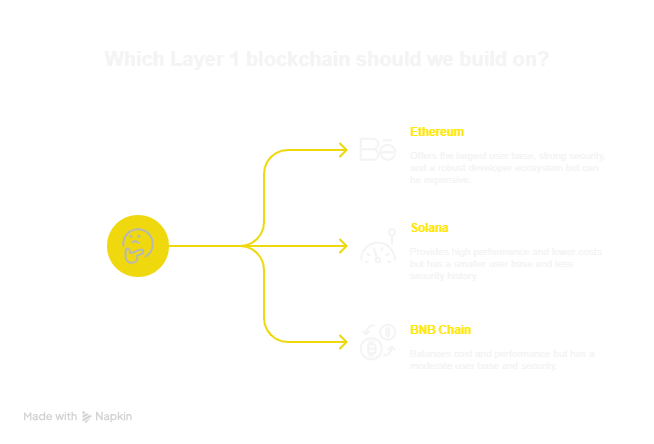
- User Base Each L1 has its own community. Building on Ethereum taps into the largest developer and user ecosystem, while Solana might give you access to a growing base of high-performance apps.
- Security Not all blockchains are equally battle-tested. Ethereum has years of security audits and billions at stake, while newer blockchains may offer speed but less history of resilience. When building enterprise blockchain solutions, security becomes even more critical.
- Costs Transaction fees (gas) differ widely. Ethereum can be expensive during network congestion, while alternatives like Solana or BNB Chain offer much lower fees. Understanding these cost implications is crucial for budgeting your project.
- Scalability If your project requires handling thousands of transactions per second (e.g., gaming), throughput is critical.
- Developer Ecosystem A larger ecosystem means more tools, libraries, and talent to build with. Ethereum leads here, but other chains are catching up fast.
- Long-Term Sustainability Consider governance, roadmap, and financial health. Some chains may not survive long-term competition.
Key Factors to Consider When Choosing a Layer 1
When evaluating blockchains, weigh these factors carefully:
<5 id="1. Transaction Speed and Scalability">1. Transaction Speed and Scalability- Ethereum: Around 15 transactions per second (TPS) on mainnet, but scaling solutions like rollups boost capacity.
- Solana: Advertises up to 65,000 TPS, making it attractive for high-frequency use cases.
- Avalanche: ~4,500 TPS, with subnets enabling customizable blockchains.
- BNB Chain: ~160 TPS, optimized for DeFi and NFT apps.
Question to ask: How many transactions per second does my app realistically need?
2. Transaction Costs
High gas fees can kill user adoption. Ethereum gas fees can spike to $50+, while Solana and Polygon transactions typically cost fractions of a cent.
Question to ask: Will my users tolerate high fees, or do I need near-zero transaction costs?
3. Consensus Mechanism
Different consensus models affect decentralization and energy efficiency.
- Proof of Stake (PoS): Used by Ethereum, Cardano, Avalanche, Solana. Energy efficient, faster finality.
- Delegated Proof of Stake (DPoS): Used by BNB Chain, EOS. Faster but more centralized.
Question to ask: Does my project need maximum decentralization or prioritize speed and efficiency?
4. Developer Ecosystem and Tooling
Ethereum’s ecosystem is unmatched, with robust tooling (Hardhat, Truffle, Foundry), libraries (ethers.js, web3.js), and developer talent. Other chains like Solana (Rust-based) or Avalanche are growing but may have steeper learning curves.
Question to ask: Do I have the developer resources to build on a less mature ecosystem?
5. Security and Reliability
Ethereum has survived countless attacks and secures billions in assets. Solana, while fast, has faced outages. Newer chains may still need to prove long-term reliability.
Question to ask: Can my project risk downtime or exploits?
6. Ecosystem and Network Effects
Building where users already are can accelerate adoption. Ethereum dominates DeFi and NFTs, while Solana has a vibrant DeFi and gaming community. BNB Chain thrives in retail adoption.
Question to ask: Which ecosystem aligns with my project’s audience?
7. Governance and Community Support
Some blockchains are community-driven (Cardano, Polkadot), while others are more company-driven (BNB Chain, Solana Labs). Community strength matters for upgrades, support, and long-term survival.
Question to ask: Do I value decentralized governance, or am I fine with corporate-backed ecosystems?
Layer 1 Blockchain Profiles
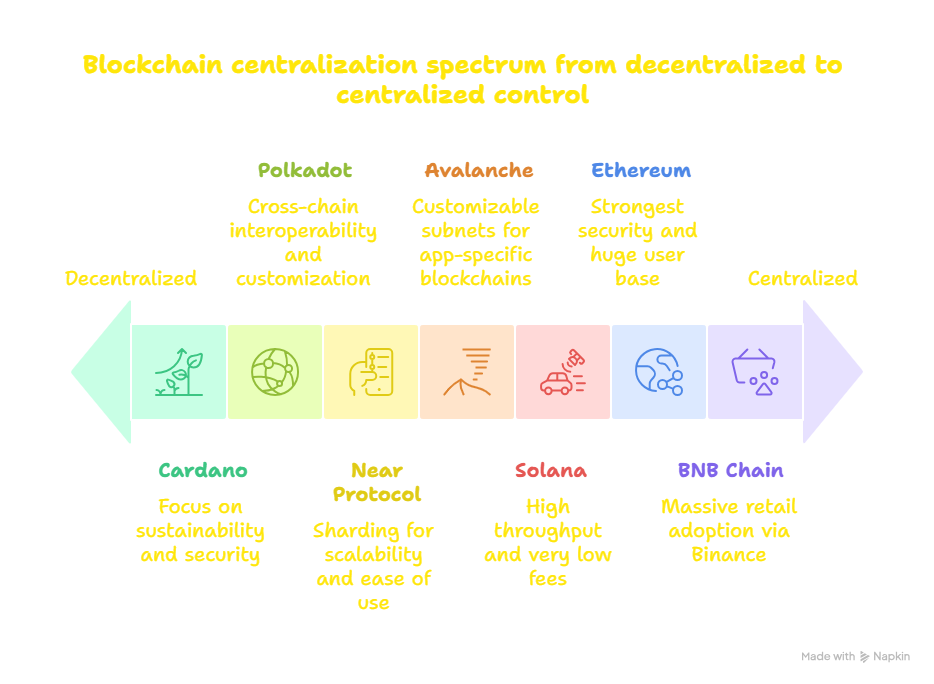
Here’s a closer look at some of the top Layer 1s:
Ethereum
- Pros: Largest developer ecosystem, strongest security, huge user base, robust tooling.
- Cons: High gas fees, lower scalability (though improving with Layer 2 rollups).
- Best for: DeFi apps, NFT projects, projects seeking maximum trust and adoption.
Solana
- Pros: High throughput, very low fees, strong adoption in gaming and NFTs.
- Cons: History of outages, more centralized validator structure.
- Best for: High-performance apps, gaming, microtransactions
Avalanche
- Pros: Fast, scalable, customizable subnets for app-specific blockchains.
- Cons: Smaller ecosystem than Ethereum.
- Best for: Enterprises, projects needing scalability with some flexibility.
BNB Chain
- Pros: Low fees, massive retail adoption (via Binance).
- Cons: Centralization concerns, reliant on Binance ecosystem.
- Best for: Retail-focused DeFi, consumer-facing apps.
Cardano
- Pros: Research-driven, secure PoS, focus on sustainability.
- Cons: Slower development, smaller DeFi/NFT adoption.
- Best for: Long-term academic-driven projects, governance-heavy apps.
Polkadot
- Pros: Cross-chain interoperability, parachains for customization.
- Cons: Complex architecture, smaller user base.
- Best for: Projects requiring multi-chain functionality.
Near Protocol
- Pros: Developer-friendly, sharding for scalability.
- Cons: Competing in a crowded field, smaller ecosystem.
- Best for: DApps with mainstream consumer focus.
Strategic Considerations for Your Project
When deciding, it’s not just about the tech—it’s about aligning with your vision and resources
- Early-Stage Projects If you're just prototyping, Ethereum testnets or Polygon may offer the easiest entry. Consider building a Progressive Web App (PWA) as your frontend to reach users across platforms.
- High-Performance Apps For gaming or social apps needing high throughput, Solana or Avalanche may be better. If you're building games, check out our game SDK comparison to understand the integration options.
- Enterprise Use Cases Avalanche subnets or Polkadot parachains allow customization and scalability. Learn more about enterprise blockchain implementation strategies.
- Retail-Focused Apps BNB Chain's large retail audience may give you faster adoption. Consider implementing Web3 passwordless authentication to improve user onboarding.
- Cross-Chain Strategies Some projects launch on multiple chains simultaneously, using bridges or interoperability layers. For data persistence across chains, explore decentralized storage solutions.
The Risk of Choosing the Wrong Layer 1
What happens if you make the wrong choice?
- Migration Costs: Moving from one blockchain to another is costly, both technically and reputationally.
- User Friction: Users may resist moving wallets and assets.
- Lost Time: Building on a chain with low adoption can delay growth.
- Security Risks: Choosing a less secure chain could expose users to exploits.
This is why careful evaluation upfront is worth the time.
The L1 landscape is evolving rapidly. Some trends to watch:
- Ethereum’s Layer 2 Ecosystem Rollups (Arbitrum, Optimism, zkSync) are making Ethereum more scalable.
- Interoperability Solutions Cross-chain platforms (Cosmos, Polkadot) are gaining traction.
- Specialized Chains App-specific chains or subnets may become more common.
- Regulatory Pressures Some L1s may face stricter oversight, affecting project adoption.
Step-by-Step Checklist for Choosing a Layer 1
- Define your project’s use case (DeFi, NFT, gaming, enterprise).
- Estimate expected transaction volume and frequency.
- Set a target for acceptable transaction fees.
- Evaluate developer resources and preferred programming languages.
- Research security history of the chain.
- Consider ecosystem size and user base.
- Align with long-term governance and sustainability.
- Pilot on testnets before committing fully.
Final Thoughts
Choosing the right Layer 1 blockchain for your Web3 project is a strategic business decision as much as a technical one. While Ethereum remains the most dominant ecosystem, alternatives like Solana, Avalanche, BNB Chain, and Polkadot offer compelling trade-offs in speed, cost, and scalability.