
The online food delivery market generates over $300 billion globally and continues to grow as consumer preference for convenience deepens. While market leaders like Zomato, Swiggy, DoorDash, and Uber Eats dominate major metros, regional and niche food delivery platforms consistently find profitable positions in underserved markets, specialty cuisine verticals, and business meal delivery.
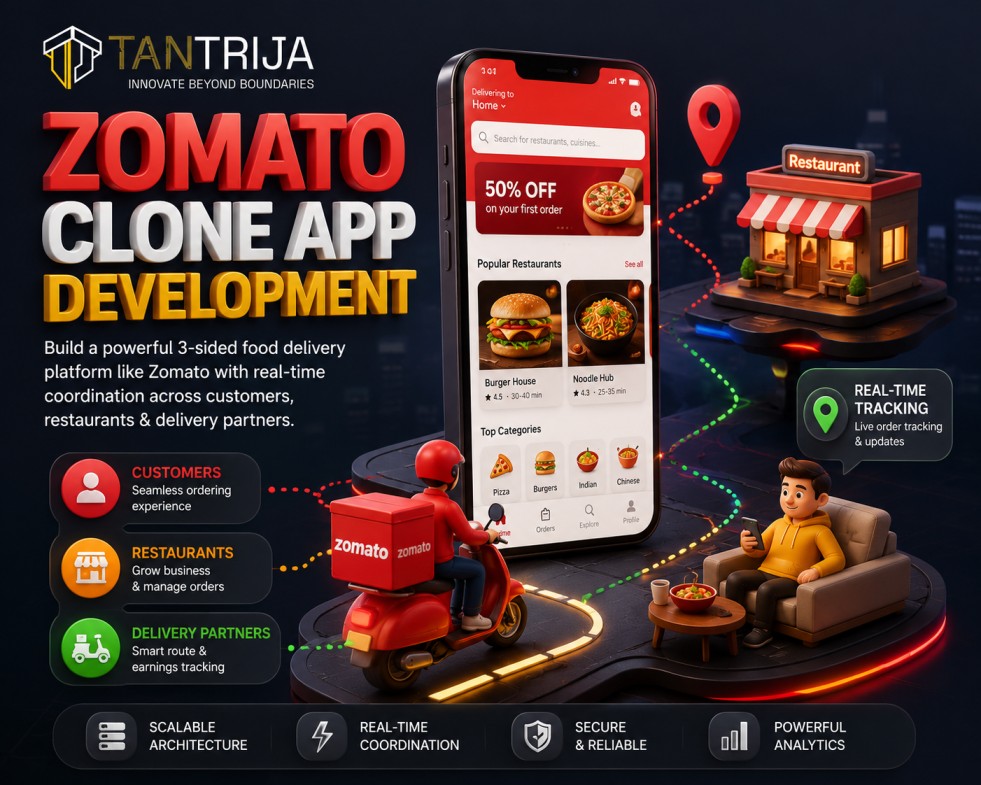
Building a Zomato clone app requires a three-sided marketplace architecture - customers, restaurants, and delivery partners with real-time coordination across all three. A successful Zomato clone app development process involves designing scalable systems for order management, live tracking, restaurant onboarding, and delivery optimization. This guide covers the architecture, features, tech stack, and cost of building a production-grade food delivery platform.
The Three-Sided Architecture of a Food Delivery App
Customer App: Browse restaurants, place orders, track delivery in real time, manage past orders and favorites, apply promo codes, and make payments. This is the highest-traffic, highest-design-polish component.
Restaurant Dashboard: Accept/reject orders, manage menu items and availability, view order queue with kitchen display system integration, and track daily revenue and ratings.
Delivery Partner App: Receive delivery assignments, navigate to restaurant and customer, mark order picked up and delivered, view earnings and ratings. Must work reliably in low-connectivity environments.
Admin Panel: Manage all restaurants, delivery partners, and customers; view platform analytics; manage promotions, disputes, and payouts.
Core Features of a Zomato Clone
Customer App
The customer app is designed to provide a convenient and engaging food ordering experience. Users can easily discover nearby restaurants using filters such as cuisine type, ratings, delivery time, and price range. The app offers real-time order tracking with live driver location updates and dynamically adjusts estimated delivery times based on traffic conditions and restaurant preparation status. Customers can choose from multiple payment methods, including cards, UPI, digital wallets, and cash on delivery, while also having the option to schedule orders for future delivery. To enhance user engagement, the app includes ratings and reviews for restaurants and delivery partners, along with promotional offers, loyalty rewards, and referral programs that encourage repeat orders and customer retention.
Restaurant Dashboard
The restaurant dashboard simplifies day-to-day operations by enabling efficient order management, menu updates, and business monitoring. It provides instant order alerts, flexible menu and operating hour controls, and essential analytics such as revenue, order trends, popular items, and average order value to help restaurants optimize performance.
Delivery Partner App
The delivery partner app helps drivers manage deliveries efficiently through smart order assignment based on location, availability, and restaurant proximity. It includes built-in navigation, detailed order information with customer instructions, and an earnings dashboard that provides clear insights into daily, weekly, and monthly income.
Real-Time Order Tracking Architecture
The real-time order tracking system enables customers to monitor deliveries with live GPS updates. The delivery partner app continuously shares location data with the backend, which processes and delivers updates to the customer app in real time. Dynamic ETA calculations based on traffic and route conditions ensure accurate delivery estimates and a seamless tracking experience.
The system must handle thousands of concurrent tracked deliveries without degrading location update frequency or introducing visible lag.
Tech Stack for Zomato Clone Development
Backend: Node.js with microservices (Order service, Tracking service, Notification service, Payment service); PostgreSQL for transactional data; Redis for session, caching, and pub/sub.
Maps & Geolocation: Google Maps Platform -Places API for restaurant discovery, Maps SDK for tracking, Distance Matrix for ETA, Directions API for delivery navigation.
Real-Time: Socket.io for WebSocket tracking updates; Firebase Cloud Messaging for push notifications.
Payments: Stripe or Razorpay (for Indian market) for card and wallet payments; UPI gateway integration.
Mobile: React Native or Flutter for customer and delivery partner apps; React dashboard for restaurants and admin.
Storage: AWS S3 for restaurant photos and menu images; CloudFront CDN for fast image delivery.
Zomato Clone App Development Cost
MVP (customer app + restaurant dashboard + basic tracking): $35,000 -$65,000
Full platform (all 4 panels + real-time tracking + multiple payment methods): $70,000 -$140,000
Enterprise-grade with AI recommendations and advanced analytics: $150,000+
Timeline for a full platform with mobile apps for all three sides typically runs 18–26 weeks with a team of 6–8 developers.
Why Tantrija for Zomato Clone Development
Tantrija has built marketplace platforms with real-time tracking, geospatial search, and multi-sided payment flows -the core technical challenges in food delivery app development. Our Zomato clone development services cover all four panels, full payment integration, real-time GPS tracking, and deployment on scalable cloud infrastructure. We deliver production-ready platforms built for the operational realities of food delivery at scale.
Conclusion
Building a food delivery app like Zomato is a significant but well-understood engineering challenge. The real competitive differentiation comes from product decisions -hyperlocal restaurant relationships, delivery time reliability, and loyalty program design -not just technology. With the right development partner handling the technical heavy lifting, you can focus on the market strategy that will define your platform's success.