
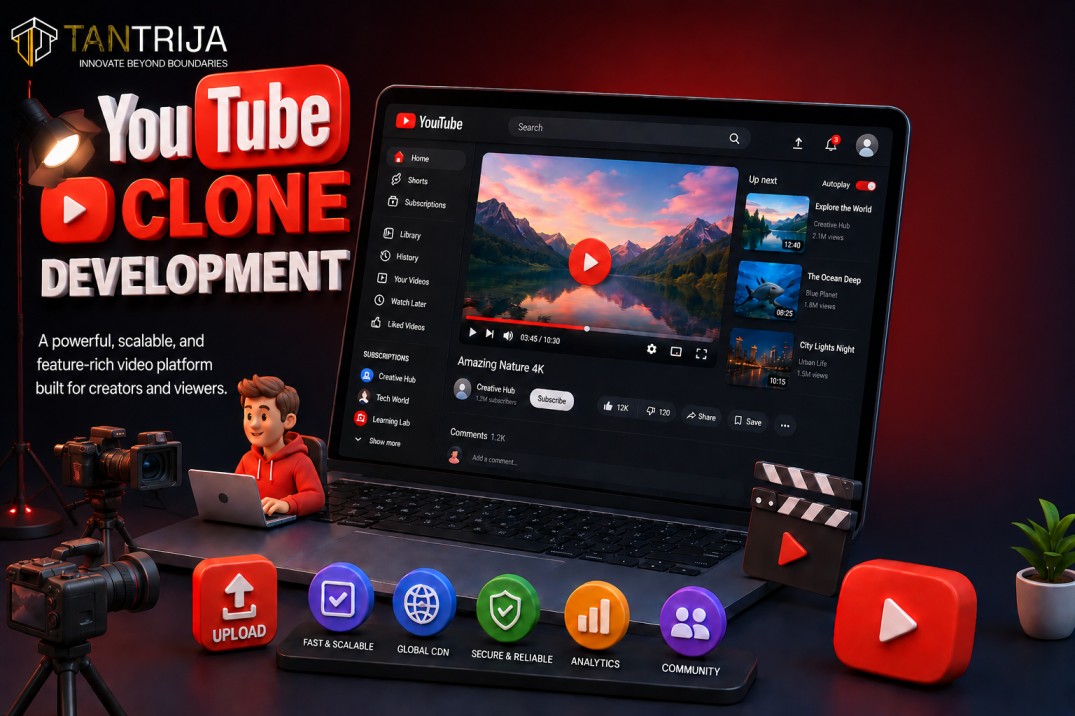
Video is the dominant content format on the internet, and user-generated video platforms continue to attract investment and audience growth. While YouTube commands a near-monopoly on general-purpose video, niche video platforms thrive in verticals where YouTube's content policies, recommendation algorithm, or monetization model create friction for creators and audiences. Education, sports, religious content, adult entertainment, and professional B2B video are all categories with active niche platform development.
Building a YouTube Clone App Development solution requires solving real engineering challenges in video ingestion, transcoding, global CDN delivery, and recommendation systems challenges that demand deliberate architectural decisions from day one. A successful YouTube Clone App Development project must focus on scalability, performance, content delivery optimization, and seamless user experiences to compete in today's video streaming landscape.
Types of Video Streaming Platforms
User-Generated Content (UGC) Platform: YouTube model -creators upload, platform distributes, advertising monetizes. High infrastructure cost, high content volume, requires robust content moderation.
OTT (Over-the-Top) Streaming: Netflix/Hulu model -curated professional content, subscription monetization, DRM protection. Appropriate for media companies, sports leagues, and niche content brands.
Live Streaming Platform: Twitch model -real-time broadcasts with chat interaction, subscriptions, and gifting. Requires WebRTC or RTMP ingest infrastructure with low-latency HLS delivery.
Enterprise Video Platform: Private video hosting for internal corporate communications, training, and events -like a private YouTube for company use.
Video Infrastructure Architecture
Video Ingestion & Storage
When a user uploads a video, the raw file must be ingested, stored, transcoded, and made available for streaming. The workflow is: upload to S3 (or GCS) temporary storage → trigger transcoding pipeline → generate multiple resolution variants and streaming manifests → push to CDN origin storage.
Video Transcoding
Raw video uploads arrive in various formats, resolutions, and codecs. Transcoding converts them to standardized delivery formats: H.264 and H.265 (HEVC) for video, AAC for audio, in multiple resolutions (360p, 480p, 720p, 1080p, 4K). For streaming, the output is segmented into HLS (HTTP Live Streaming) or DASH (Dynamic Adaptive Streaming) manifests that allow the player to adapt quality based on available bandwidth.
AWS Elastic Transcoder / MediaConvert: Managed transcoding service -no infrastructure to manage, per-minute pricing, integrates with S3 natively.
Mux: Managed video infrastructure API covering ingest, transcoding, storage, CDN, and analytics. The fastest path to production-ready video streaming.
FFmpeg on EC2/ECS: Self-managed transcoding using FFmpeg on containerized workers. Maximum control, lower per-minute cost at scale, but requires infrastructure engineering.
Content Delivery Network (CDN)
Video delivery without a CDN is not viable at any meaningful scale. The CDN caches video segments in edge locations close to viewers, reducing latency and offloading bandwidth from the origin server. Cloudflare Stream, AWS CloudFront, Bunny CDN, and Fastly are all appropriate choices depending on scale and cost requirements. Global delivery of 1080p video at 5 Mbps bitrate to thousands of concurrent viewers requires a CDN -there is no alternative.
Core Features of a YouTube Clone
Creator Features
A YouTube clone should provide creators with a complete set of tools to upload, manage, and grow their content efficiently. Creators can upload videos with real-time progress indicators and background processing updates, while built-in editing tools allow them to trim videos, add chapters, upload custom thumbnails, and generate captions automatically using Whisper API. The platform should also support channel management features such as custom branding, playlist organization, community posts, and membership programs. Additionally, a comprehensive analytics dashboard helps creators track views, watch time, audience demographics, engagement metrics, and revenue performance, enabling them to make data-driven decisions and optimize their content strategy.
Viewer Features
A YouTube clone should deliver an engaging and seamless viewing experience through an adaptive streaming player that supports multiple quality options using technologies such as HLS/DASH with hls.js or Shaka Player. The platform should include autoplay functionality and personalized "Up Next" recommendations to keep users engaged with relevant content. Viewers should be able to interact with videos by liking, commenting, sharing, and saving content to playlists for future viewing. Subscription and notification settings allow users to stay connected with their favorite creators, while watch history and resume-watching features ensure continuity across devices. Support for Chromecast and AirPlay further enhances the experience by enabling users to stream videos directly to larger screens.
Monetization Features
A YouTube clone should include multiple monetization options to generate revenue for both creators and platform owners. Advertising can be supported through pre-roll, mid-roll, and banner ads using solutions such as Google AdSense or direct advertising partnerships. Creators can also earn recurring income through channel memberships, where subscribers pay a monthly fee to access exclusive content, badges, and premium community features. Additional revenue opportunities include Super Thanks or tipping systems that allow viewers to make one-time payments during or after video playback to support their favorite creators. For premium content, the platform can implement Pay-Per-View (PPV) functionality, enabling users to purchase access to individual videos, live events, courses, or exclusive content.
Recommendation Engine
The recommendation engine is the defining feature that separates a good video platform from a great one. A basic implementation uses collaborative filtering -users who watched A also watched B. A production recommendation system uses multi-stage ranking: candidate generation (retrieve 500 candidates from millions of videos based on user history) → scoring (rank candidates by predicted watch time, click probability, freshness) → diversity reranking (ensure topic and format diversity to avoid filter bubbles).
YouTube Clone Development Cost
Basic UGC platform (upload, transcode, player, search): $45,000 -$80,000
Full-featured platform (recommendations, monetization, live streaming): $100,000 -$200,000
Enterprise OTT with DRM and subscription management: $150,000 -$300,000+
Why Tantrija for YouTube Clone Development
Tantrija has deep expertise in video infrastructure, streaming architecture, and marketplace platform development. Our YouTube clone development services cover video pipeline setup, transcoding infrastructure, CDN configuration, mobile and web player development, recommendation system implementation, and monetization tooling. We build platforms that scale from day one.
Conclusion
Building a YouTube clone is a genuine infrastructure challenge, not just a UI project. The video processing pipeline, CDN strategy, and recommendation engine are the technical foundations that determine whether your platform can deliver a compelling viewer experience at scale. Partner with a team that has built video infrastructure in production, not just streamed a few test videos in a demo environment.