
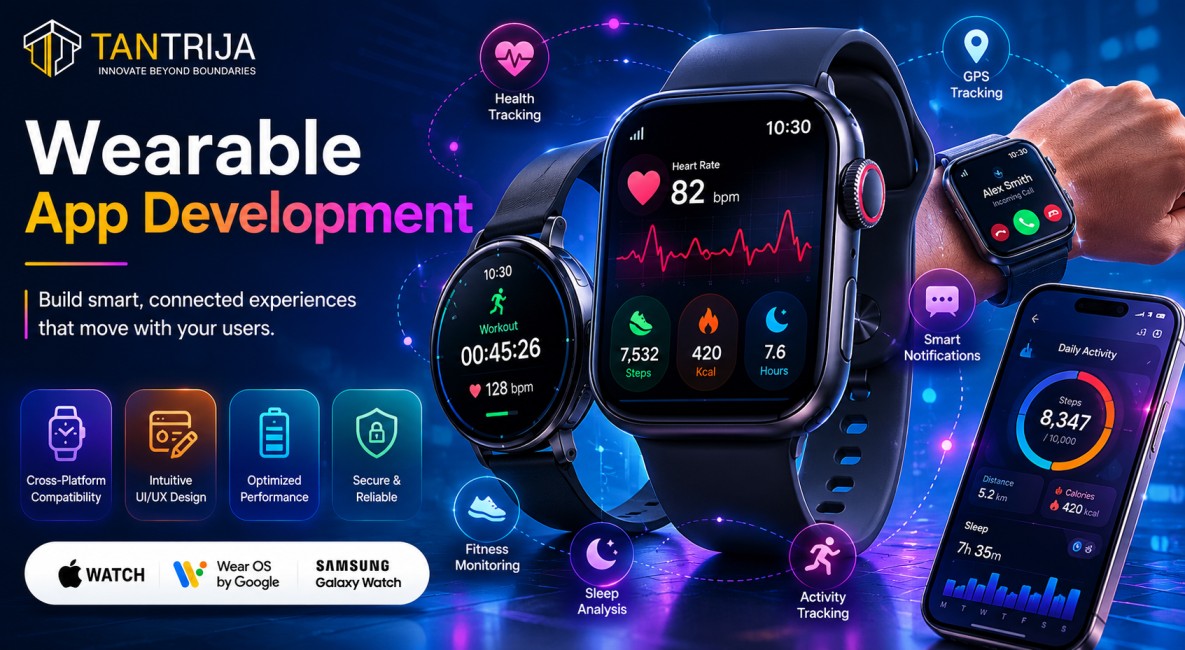
Wearables are no longer a niche technology category. Over 200 million smartwatches ship annually, and Apple Watch commands a dominant position as the leading health and fitness platform. Wear OS has matured significantly with Google's acquisition of Fitbit and Samsung's Galaxy Watch lineup. For businesses in health, fitness, enterprise, and consumer tech, wearable app development represents a high-engagement touchpoint that complements their mobile strategy.
Building for wearables requires a fundamentally different design philosophy than smartphone development. The constraints -tiny screen, glanceable interactions, limited battery life, and the physical context of being on a wrist -demand a purpose-built approach that cannot simply downsize a mobile UI.
Types of Wearable Apps
Wearable apps serve a wide range of use cases across consumer and enterprise markets. Health and fitness apps help users monitor vital metrics such as heart rate, sleep quality, blood oxygen levels, and workout performance. Enterprise and field service applications enable hands-free task management, voice-based reporting, and instant notifications for on-the-go workers. Navigation apps provide turn-by-turn directions and location-based alerts, while payment apps support secure contactless transactions through NFC technology. Smart home applications allow users to control connected devices directly from their smartwatch, and productivity apps deliver meeting reminders, email previews, calendar updates, and quick replies for enhanced efficiency throughout the day.
Apple Watch App Development
Apple Watch apps are built with SwiftUI and WatchKit, using Xcode. The watchOS SDK provides access to HealthKit for health metrics, Core Motion for accelerometer and gyroscope data, the Digital Crown for precise input, Haptic Engine for tactile feedback, and complications for the watch face.
SwiftUI for watchOS: Declarative UI framework that adapts to the Apple Watch display sizes (41mm, 45mm, 49mm Ultra). Components like List, ScrollView, and NavigationSplitView work natively on watchOS.
HealthKit Integration: Request permissions to read and write health data including heart rate, steps, calories, sleep stages, and ECG readings. Background delivery allows apps to receive health updates without the app being active.
Complications: Custom watch face complications display your app's data at a glance -ideal for fitness metrics, upcoming appointments, or contextual business data.
Independent watchOS Apps: Since watchOS 6, apps can function fully independently without a paired iPhone present, using cellular or WiFi connectivity directly from the watch.
Wear OS App Development
Wear OS apps are built with Jetpack Compose for Wear OS using Kotlin in Android Studio. Google's 2024 unification of Wear OS has made Galaxy Watch (Samsung) and Pixel Watch development much more consistent through a shared Wear OS foundation.
Jetpack Compose for Wear OS: Modern declarative UI toolkit with Wear-specific components (ScalingLazyColumn, SwipeDismissableNavHost, Chip, Button) optimized for circular and square watch displays.
Health Connect: Google's unified health data platform replaces Google Fit as the central health data store on Android. Apps read and write structured health records with user-granted permissions.
Tiles: Quick-access panels on the watch face that display app data without launching the full app -similar to Apple's complications.
Ongoing Activities: System-level integration that keeps fitness tracking sessions visible even when the user navigates away from the app.
Design Principles for Wearable Apps
Wearable app design focuses on delivering quick, intuitive experiences on small screens. Effective apps prioritize glanceable interfaces that communicate key information within seconds, use single-action screens to reduce complexity, and incorporate haptic feedback and subtle animations for seamless interactions. They are built with offline functionality, battery efficiency, and context awareness in mind, ensuring users receive relevant information and smooth performance whether they are working, exercising, traveling, or resting
Wearable App Development Cost
Simple companion app (notifications, quick actions, one health metric): $15,000 -$30,000
Full health/fitness app with HealthKit / Health Connect integration: $35,000 -$70,000
Enterprise wearable app with custom sensors and backend integration: $50,000 -$100,000+
Development for both Apple Watch and Wear OS adds approximately 40–60% to the cost of a single-platform app due to the distinct SDKs, design patterns, and testing requirements.
Tantrija's Wearable App Development Services
Tantrija's mobile team includes developers experienced with both watchOS (SwiftUI / HealthKit) and Wear OS (Jetpack Compose / Health Connect). Our wearable app development services cover end-to-end product development from UX design through App Store submission, with expertise in health data APIs, real-time sensor processing, and cross-device synchronization with companion mobile apps.
Conclusion
Wearable app development requires a genuine rethinking of product design -smaller screens, shorter interactions, and different user contexts demand purpose-built experiences rather than scaled-down mobile apps. As smartwatch adoption continues to grow and health data APIs become richer, wearable apps represent one of the highest-engagement touchpoints available to product teams in 2026.