
For years, inventory management meant a desktop terminal at a warehouse desk, updated once or twice a day by whoever had time to sit down and enter numbers. That model is quietly breaking down, not because the software got worse, but because the businesses using it changed faster than the tools did.
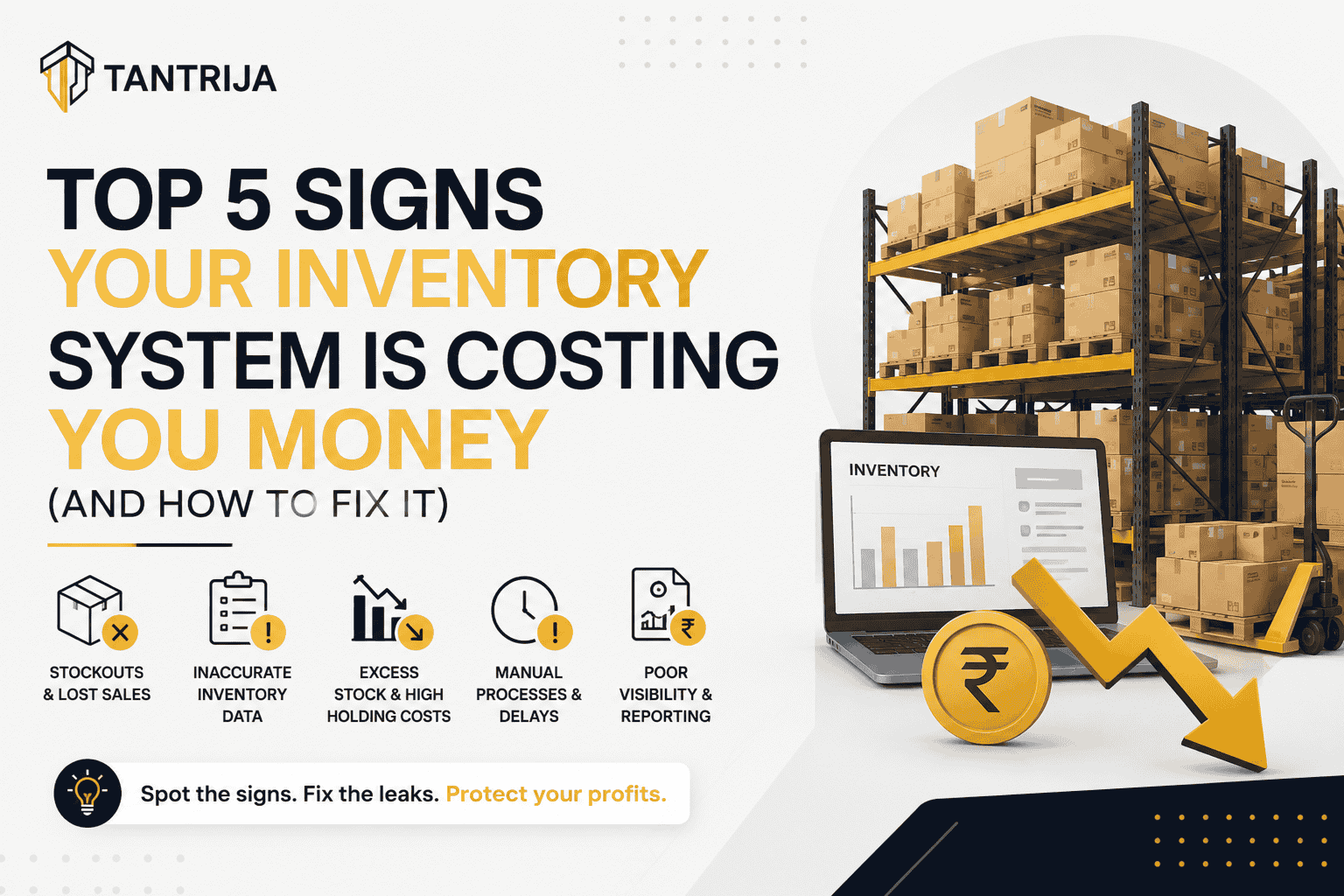
A warehouse floor, a retail counter, and a delivery vehicle are not desks. Stock gets moved, sold, damaged, or returned in real time, in places far from a fixed terminal. Here are the five clearest signs that gap is already costing your business money, and what actually fixes each one.
1. You're overselling stock that's already gone
If a customer orders something your system says is available, but it isn't on the shelf, that's not a one-off mistake, it's a symptom of a system that only reflects reality once or twice a day instead of in real time. The fix: a mobile-first system where stock updates the moment an item is scanned out, not at end of day.
2. You're reordering items that are actually still in stock
The opposite problem is just as costly: placing a fresh order for something that's sitting untouched in a back room, simply because it was never logged as received or moved. The fix: barcode or QR-based scanning at every handoff point, so stock counts stay accurate without relying on someone remembering to update a spreadsheet later.
3. You can't tell which SKUs are actually moving
Without real-time data, sales velocity is a guess based on gut feeling rather than actual numbers. Slow-moving stock quietly ties up capital while fast-moving items run out unnoticed. The fix: a live dashboard showing real sale velocity per item, not a static report generated once a week.
4. Multiple locations never show the same numbers at the same time
If you run more than one site, warehouse and storefront, or multiple retail branches, and each one reports numbers that don't reconcile in real time, you're managing the business partially blind. The fix: a centralized mobile system where every location updates the same live inventory record, visible to management instantly, not stitched together from separate end-of-day reports.
5. Reordering decisions are based on static rules, not real demand
Fixed reorder points ("reorder when stock hits 10 units") ignore seasonality, promotions, and actual demand patterns specific to your business. The fix: AI-driven demand forecasting built on your own real usage data, predictive reordering based on actual sale velocity, and automatic alerts before a fast-moving item runs out, not generic industry assumptions applied to your business.
The audit worth running this week
The businesses seeing the clearest gains from fixing these five issues aren't necessarily the largest ones. A retailer with two or three locations, or a manufacturer coordinating between a factory floor and a warehouse, often has the most to gain, since the coordination gap between locations is exactly what a real-time mobile system closes.
The question worth asking honestly isn't "do we need new inventory software." It's "how much money is currently being lost to the gap between what our system says we have and what we actually have." For most businesses running this audit for the first time, that gap turns out to be larger than expected.
Tantrija builds mobile-first inventory and operations systems for retailers and manufacturers. See our work or talk to us about your specific operational bottleneck.