
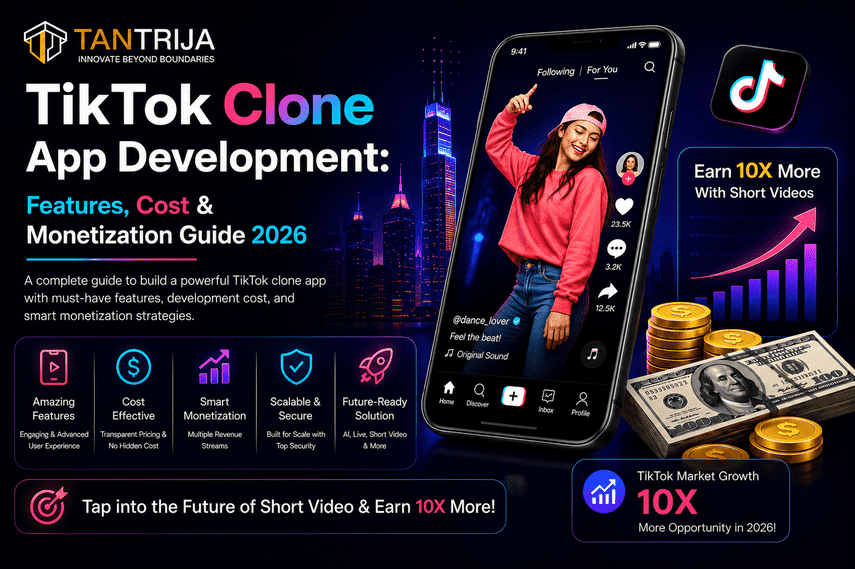
Short-form video is the dominant content format of the 2020s. TikTok's algorithm-driven discovery feed reshaped how people consume content and how brands reach audiences. Yet despite TikTok's dominance, there is strong market demand for niche short-video platforms serving specific communities, regional markets, professional verticals, education, sports, and adult content platforms where a general-purpose app either does not serve the audience or faces content moderation constraints.
Building a TikTok clone app in 2026 means building a platform that can ingest, process, and deliver short-form video at scale, with the AI-powered recommendation engine that makes the format addictive. Here is what it takes.
Core Features of a TikTok Clone App
A successful TikTok clone app requires advanced content creation tools that allow users to create engaging videos effortlessly. These tools typically include an in-app camera with multi-clip recording and trimming, green screen or virtual background support, speed control from 0.3x to 3x, duet and stitch functionality for collaborative content, text overlays, stickers, filters with real-time preview, and support for licensed music libraries or original audio uploads.
The AI-powered discovery feed is the foundation of user engagement. TikTok’s “For You Page” works through a recommendation engine that analyzes watch time, completion rate, shares, comments, likes, re-watches, profile visits, and skip events. A TikTok clone app development platform uses collaborative filtering or advanced neural network models to rank and personalize content for each user in near real time.
Social interaction features are equally important for audience retention and creator growth. Users should be able to follow creators, like and comment on videos, share content, and create duets. Additional engagement tools such as live streaming with gifting and Q&A sessions, direct messaging between users, trending hashtag discovery, and creator analytics dashboards help increase platform activity and creator participation.
Monetization features transform a TikTok clone into a scalable business platform. Common monetization options include in-app currency systems for gifting during live streams, creator funds that share revenue based on engagement, branded partnerships connecting creators with advertisers, in-feed video advertisements, branded effects, and paid subscriptions for exclusive LIVE content.
Tech Stack for TikTok Clone Development
Developing a scalable short-video platform requires a strong technology stack. Video processing is commonly handled using FFmpeg, AWS Media Convert, or Mux to transcode videos into multiple resolutions such as 240p, 480p, 720p, and 1080p with HLS/DASH streaming support. For content delivery and storage, AWS Cloud Front with S3 or Bunny CDN helps ensure low-latency global streaming performance.
The recommendation engine is generally powered by Python-based machine learning pipelines using Tensor Flow or Py Torch, combined with Apache Kafka for real-time event streaming and Redis for caching recommendations. Backend systems are often built using microservices architecture in Node.js or Go, separating services such as authentication, video management, feed generation, social graph handling, and notifications.
For mobile app development, React Native and Flutter remain popular cross-platform frameworks, while native camera modules are integrated for smoother video recording performance. Real-time functionality such as live chat and live streaming is commonly implemented through Web Socket technology and streaming SDKs like Agora or ZEGOCLOUD. Databases such as PostgreSQL, Redis, Elasticsearch, Cassandra, or DynamoDB are typically used to manage user data, search indexing, caching, and high-volume event logging.
TikTok Clone App Development Cost
The development cost of a TikTok clone app depends heavily on feature complexity and scalability requirements. A basic MVP with video recording, feeds, follows, and likes generally costs between $35,000 and $65,000. A full-featured platform with AI recommendations, live streaming, and monetization capabilities can cost between $80,000 and $180,000. Enterprise-grade applications with custom CDN infrastructure and advanced machine learning pipelines may exceed $200,000.
The AI recommendation engine is often the most expensive component. A basic collaborative filtering system may add around $15,000 to $30,000 to the project budget, while a sophisticated real-time neural network recommendation system can increase costs by $40,000 to $70,000.
Timeline for TikTok Clone Development
The timeline for TikTok clone app development varies based on project scope. Discovery and architecture planning generally require around two weeks, while video infrastructure setup for recording, processing, and CDN integration can take approximately four weeks. Building the recommendation engine and feed system typically requires three weeks, followed by social feature development, creator tools, live streaming integration, and monetization systems, each taking additional development time. Testing, quality assurance, optimization, and deployment also require several weeks before launch.
A complete enterprise-grade TikTok clone platform generally takes around 20 to 26 weeks to develop, while a lightweight MVP with only essential features can be launched within 12 to 14 weeks.
Why Tantrija for TikTok Clone Development
Tantrija specializes in video infrastructure, real-time systems, and mobile app development, which are the core requirements for a production-grade TikTok clone platform. Our TikTok clone app development services include AI recommendation engine integration, video processing pipeline development, mobile application development, and live streaming infrastructure setup. We focus on building scalable architectures capable of supporting millions of users and videos from the initial launch stage.
Conclusion
Building a TikTok clone app requires expertise in machine learning, video processing, cloud infrastructure, and real-time streaming systems. Success in the short-video industry depends on delivering a highly engaging recommendation engine, powerful creator tools, and scalable monetization features. Choosing the right development partner ensures your platform is prepared for long-term growth and user engagement.