

The cryptocurrency exchange landscape has evolved dramatically from the early days of simple trading platforms to today's sophisticated, institutional-grade financial infrastructure. Behind every seamless trade, live price update, and secure transaction lies a complex ecosystem of bleeding-edge technologies operating in perfect concert. Understanding these technologies isn't just an academic interest—it's a necessity for anyone looking to build, invest in, or work with modern crypto exchanges.
As the crypto market matures and regulatory environments are set in stone, the technology behind these platforms has grown ever more advanced. Today's exchanges need to support millions of transactions a second, achieve 99.99% uptime, and deliver banking-level security with a lightning-fast user experience. In this article, we're going behind the scenes to discuss the crucial technologies that enable modern crypto exchanges.
The Architectural Foundation: Building for Scale and Security
Microservices Architecture
Contemporary crypto exchanges have come a long way from monolithic architectures, where a single, massive codebase handled everything. Today's top platforms are engineered using microservices architectures, which are like a collection of independent, specialist teams collaborating to build a single product, rather than a single, slow-moving company. This facilitates individual components to scale separately and fail safely. For instance, during a peak trading event, the order matching engine can process a huge load while other services, such as user authentication, operate with regular capacity.
The microservices architecture also supports continuous deployment and testing, which is very important for 24/7-running platforms that cannot afford any long periods of downtime for maintenance. Individual services can be independently updated, tested, and deployed, minimizing system-wide risks and allowing for quicker feature rollouts. Professional blockchain development solutions recognize that this architectural style is not solely about scalability; it's about creating robust systems that can keep up with the quickly changing crypto environment while still delivering the reliability institutional clients rquire.
High-Performance Database Systems
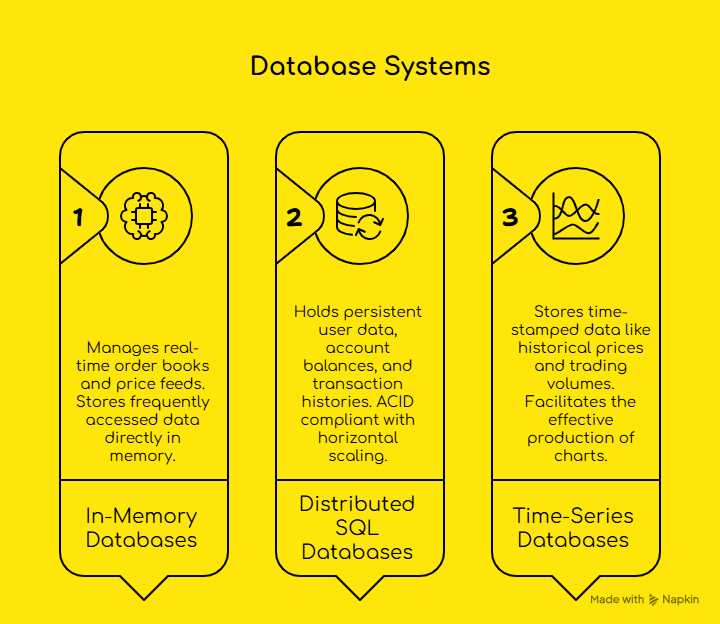
The core of any cryptocurrency exchange is its database infrastructure. Contemporary exchanges usually use a hybrid model, with various database technologies suited to particular use cases. Ponder it as a specialized toolkit, where every tool has a specific purpose:
In-Memory Databases such as Redis serve as the "short-term memory of the brain," managing real-time order books and price feeds. These platforms store frequently accessed data directly in memory, providing microsecond responses to mission-critical trading activities by avoiding slow disk I/O bottlenecks.
Distributed SQL Databases like CockroachDB or PostgreSQL clusters are the "long-term memory," holding persistent user data, account balances, and transaction histories. These systems are ACID compliant (ensuring data integrity and reliability for every transaction) with horizontal scaling across many nodes.
Time-Series Databases such as InfluxDB are the "historical record keeper" and are optimized to store time-stamped data like historical prices, trading volumes, and performance metrics. This specialized storage facilitates the effective production of charts, analytics, and algorithmic trading signals.
Real-Time Matching Engines
The matching engine is arguably the most important part of any cryptocurrency exchange. This system matches sell and buy orders, settles trade prices, and carries out transactions—all in real time. To reduce latency and increase throughput, modern matching engines are generally constructed in low-level languages such as C++ or Rust.
Advanced matching engines use sophisticated algorithms to provide equitable order execution, support various order types (market, limit, stop-loss), and manage order books for multiple trading pairs in parallel. The engine also needs to support intricate edge cases such as partial executions, order cancellations, and network failures while maintaining data integrity.
Security Technologies: Securing Digital Assets
Multi-Signature Wallet Infrastructure
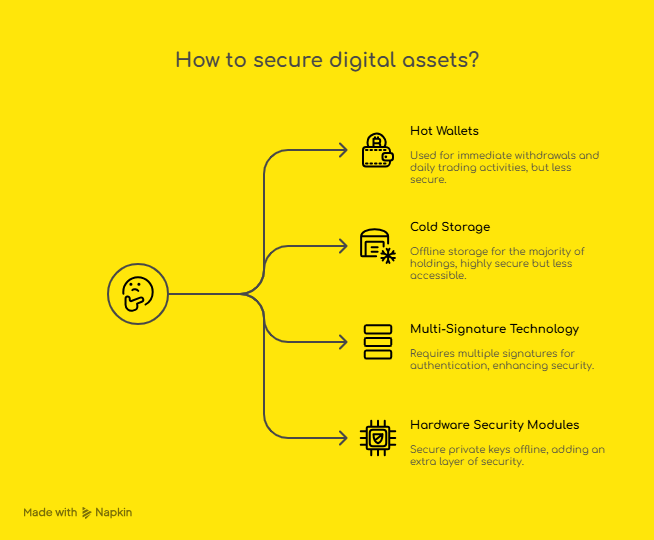
Current crypto exchanges utilize advanced wallet architectures that balance security and transaction efficiency. Hot wallets undertake daily trading activities and need to be readily available for immediate withdrawals. However, the overwhelming majority of customer holdings are secured in cold storage systems, which are kept offline and disconnected from the internet.
Multi-signature technology demands multiple cryptographic signatures to authenticate transactions, like a vault that needs two or more keys to open. This ensures there is no single point of failure. Major exchanges also use time-locked transactions, hierarchical deterministic wallets, and hardware security modules (HSMs) to secure private keys. The careful orchestration between exchange systems and crypto wallet development is required to preserve security while ensuring a user-friendly experience. This involves establishing secure API connections, automated reconciliation mechanisms, and real-time surveillance for malicious activities.
Advanced Encryption and Security Protocols
Beyond plain HTTPS, advanced exchanges use several layers of security protocols and encryption:
End-to-End Encryption guards sensitive information for its entire lifecycle, from user input to storage in a database. This includes encrypting API communications, database records, and internal service communications.
Zero-Knowledge Architectures do not allow even exchange operators to see specific user data. These architectures enable users to prove ownership or authorization without exposing the underlying sensitive data.
Real-time Fraud Detection systems employ machine learning algorithms to function as a cybersecurity guard that continuously scans for suspicious patterns of trading, unusual account behavior, and potential dangers. These systems can automatically freeze accounts, request additional verification, or initiate manual security checks.
Frontend Technologies: Building Smooth Trading Experiences
Progressive Web Applications (PWAs)
Contemporary crypto exchanges are increasingly developed as Progressive Web Applications (PWAs), which offer a quick, native app-like experience within a web browser. PWAs support real-time updates, offline support, and push notifications while maintaining cross-platform compatibility.
These apps leverage technologies such as WebSocket connections for real-time price streams, Service Workers for background syncing, and Web Workers for intensive calculations that do not lock up the user interface. The result is a trading platform that feels as responsive as a desktop application yet is accessible from anywhere.
Advanced Charting and Analytics
Professional trading platforms demand advanced charting functionality capable of managing huge datasets and updating in real-time. Advanced exchanges use technologies such as:
WebGL Rendering that supports seamless, hardware-accelerated animations of charts and intricate visualizations that remain responsive even for thousands of data points.
Stream Processing frameworks that can aggregate and analyze trading data in real-time, presenting instant technical indicators, volume analysis, and market depth visualization.
Algorithmic Trading Integration that enables users to apply automated trading strategies, backtesting features, and API access for professional trading software.
Blockchain Integration: Access to the Decentralized World
Multi-Blockchain Support
Modern exchanges are required to support dozens of disparate blockchain networks, each with its own characteristics, consensus algorithms, and technical specifications. This necessitates advanced blockchain integration layers that can:
Support multiple transaction types and signing methods for numerous networks, ranging from Bitcoin's UTXO model to Ethereum's account-based model and more recent designs such as Solana's performance-oriented blockchain.
Integrate automated deposit and withdrawal mechanisms that can track multiple blockchain networks at once, identify incoming transactions, and execute withdrawals with requisite confirmations and security scanning.
Support cross-chain exchanges and DeFi protocol integrations that allow users to use decentralized finance directly from the interface of centralized exchanges.
Smart Contract Integration
Contemporary exchanges increasingly have in-built integrations with smart contracts as well as DeFi protocols, necessitating complex integration layers that are able to engage with a range of blockchain ecosystems. These include:
Automated Market Maker (AMM) Integration that enables decentralized liquidity access but preserves the centralized exchange interface.
Yield Farming and Staking Services that integrate exchange balances with other DeFi protocols, allowing users to earn rewards on their balances.
NFT Marketplace Integration for enabling trading of non-fungible tokens in addition to traditional cryptocurrencies.
Infrastructure and DevOps: Maintaining Global Operations
Global Content Delivery Networks
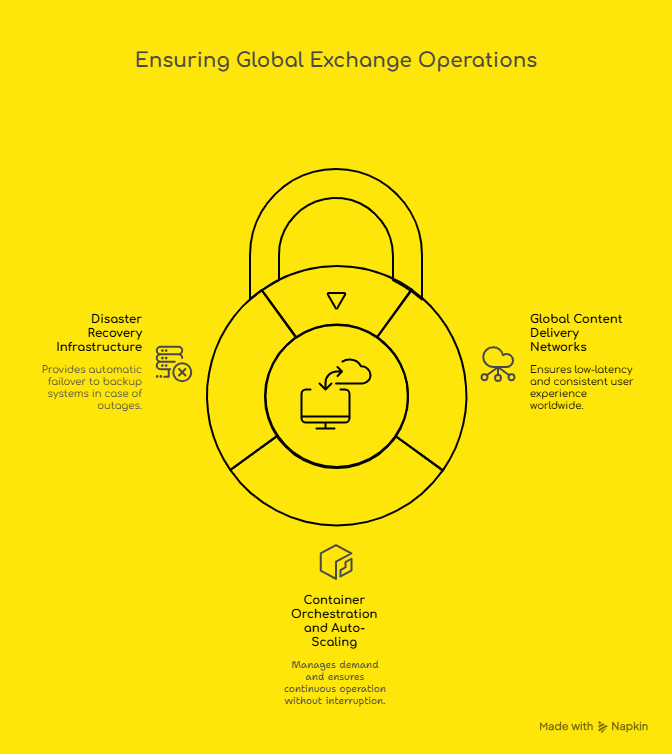
Cryptocurrency exchanges need to serve users globally and ensure a consistent, low-latency experience across geographic regions. This necessitates advanced CDN (Content Delivery Network) deployments that can:
Cache static content and API responses at edge locations across the globe, lowering load times and server strain in periods of high traffic.
Enforce geo-routing that connects individuals to the closest data center with session consistency and data sync across regions.
Deal with DDoS protection and traffic filtering on the network perimeter, shielding core infrastructure from nefarious attacks.
Container Orchestration and Auto-Scaling
Advanced exchanges operate on containerized infrastructure, leveraging platforms such as Kubernetes that facilitate:
Real-time demand-based automatic scaling to ensure trading systems can absorb unexpected spikes in volume without degradation in performance.
Rolling Updates that support continuous deployment without interruption, which is essential for exchanges running 24/7 across global markets.
Disaster Recovery infrastructure that can failover automatically to backup infrastructure in the event of regional outages or hardware failure.
The Future of Crypto Exchange Technology
Artificial Intelligence and Machine Learning
Future generations of crypto exchanges will utilize AI and machine learning in ways never before seen:
Predictive Analytics will assist exchanges in maximizing liquidity, anticipating market movements, and offering users smart trading insights.
Automated Customer Support based on natural language processing will deal with day-to-day inquiries and offer 24/7 multiple-language support.
Risk Management systems will employ machine learning to identify fraud, spot market manipulation, and achieve regulatory compliance in real time.
Quantum-Resistant Security
With the development of quantum computing, crypto exchanges are already starting to add quantum-resistant cryptographic algorithms into their security infrastructure to future-proof it. This involves post-quantum signature schemes and encryption techniques that are resistant to quantum computer attacks.
Building Tomorrow's Exchanges Today
The infrastructure driving today's crypto exchanges is among the most advanced ever constructed. These systems have to balance traditional banking security needs and the requirements for high-frequency trading performance while operating in a 24/7 international market with changing regulatory demands.
For entities wishing to get into the crypto exchange space or upgrade current platforms, the most important thing is to partner with development teams that grasp not only the various technologies but also the way in which they interact to build secure, scalable, and easy-to-use trading platforms.
The crypto exchange landscape will continue evolving rapidly, driven by technological advances, regulatory changes, and user demands for better experiences. Success in this space requires not just understanding current technologies but anticipating future trends and building adaptable systems that can evolve with the market.
Whether you're a programmer wanting to learn about the technology behind crypto exchanges, an exchange executive considering exchange partnerships, or an entrepreneur thinking about launching your own platform, it's essential to learn about these technologies to better navigate the complicated and fast-changing landscape of cryptocurrency trading infrastructure.
The future is with exchanges that can effortlessly marry top-notch technology with regulation, institutional-grade security, and consumer-friendly experiences. The technology infrastructure is already available—the question is how well organizations manage to use it as a foundation for building the next generation of crypto trading platforms.