
Smart contracts are revolutionizing how businesses operate across multiple sectors, with global spending on blockchain solutions expected to reach $67 billion by 2026. These self-executing contracts with terms directly written into code are eliminating intermediaries, reducing costs, and increasing transparency in supply chains, healthcare, and financial services.
What Are Smart Contracts and Why Do They Matter?
Smart contracts are digital agreements that automatically execute when predetermined conditions are met. Unlike traditional contracts that require manual verification and enforcement, smart contracts operate on blockchain networks, ensuring transparency, immutability, and automatic execution without intermediaries.
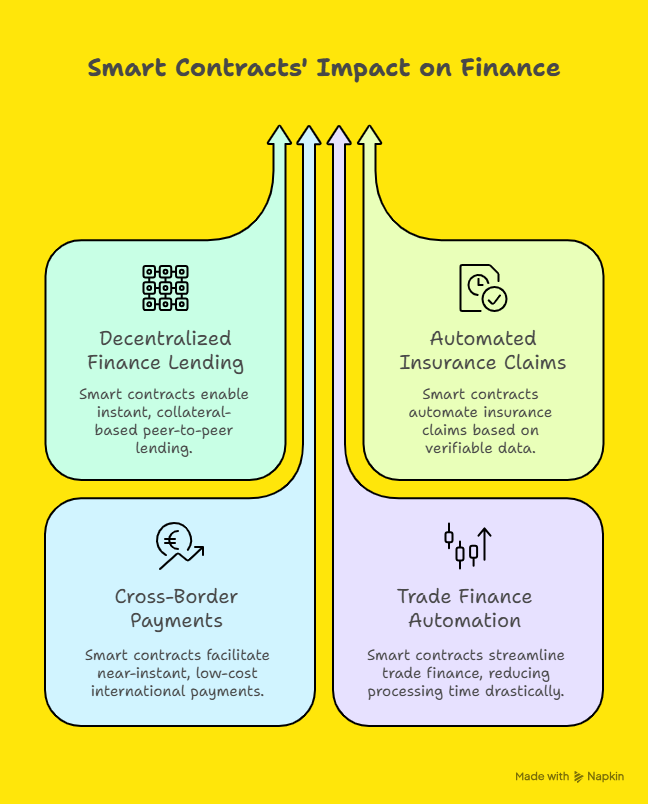
Key benefits include:
- Reduced transaction costs by eliminating middlemen
- Faster processing times through automation
- Enhanced security via cryptographic protection
- Improved transparency with immutable records
- Decreased human error through automated execution
Smart Contracts in Supply Chain Management
Transforming Global Trade and Logistics
Supply chain management faces numerous challenges, including a lack of transparency, counterfeiting, and inefficient tracking systems. Smart contracts address these issues by creating an immutable ledger of transactions and automated processes.
Real-world applications:
Product Authentication and Anti-Counterfeiting Smart contracts can verify product authenticity at each stage of the supply chain. When a product moves from manufacturer to distributor to retailer, the smart contract automatically updates its status and verifies authenticity markers, making counterfeiting extremely difficult.
Automated Payments and Settlements. Traditional supply chain payments often involve lengthy approval processes and multiple intermediaries. Smart contracts can automatically release payments when delivery conditions are met, reducing payment delays from weeks to minutes.
Quality Control and Compliance: Smart contracts can automatically enforce quality standards. For example, if temperature sensors in a food shipment detect temperatures outside acceptable ranges, the smart contract can automatically reject the shipment and trigger insurance claims.
Smart Contracts in Healthcare
Securing Patient Data and Streamlining Operations
Healthcare systems worldwide struggle with data security, interoperability, and administrative inefficiencies. Smart contracts provide solutions that safeguard patient privacy while facilitating secure data sharing and automating processes.
Key applications:
Patient Data Management and Privacy Smart contracts can control access to patient medical records, ensuring only authorized healthcare providers can access specific information. Patients maintain ownership of their data while enabling secure sharing for treatment purposes.
Insurance Claims Processing: Healthcare insurance claims processing is notoriously slow and prone to disputes. Smart contracts can automatically verify claims against policy terms and medical records, processing legitimate claims instantly while flagging suspicious ones for human review.
Drug Supply Chain and Anti-Counterfeiting Counterfeit medications pose serious health risks. Smart contracts can track pharmaceutical products from manufacturing through distribution, ensuring authenticity and preventing fake drugs from entering the supply chain.
Clinical Trial Management Smart contracts can automate patient recruitment, consent management, and data collection in clinical trials while ensuring regulatory compliance and data integrity.
Real-World Implementation: MedRec
MIT's MedRec system uses smart contracts to give patients control over their medical data while enabling healthcare providers to access necessary information securely. The system has shown promising results in pilot programs, reducing administrative costs by up to 30% while improving data accuracy.
Smart Contracts in Financial Services
Revolutionizing Traditional Banking and Insurance
The financial sector was among the first to recognize smart contracts' potential, with applications ranging from automated lending to insurance claim processing.
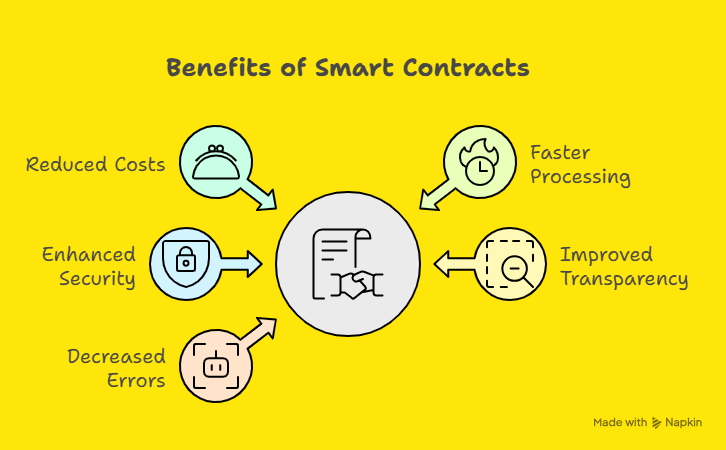
Major applications:
Decentralized Finance (DeFi) Lending Smart contracts enable peer-to-peer lending without traditional banks. Borrowers can access loans instantly by providing cryptocurrency collateral, with smart contracts automatically liquidating collateral if loan terms are violated.
Automated Insurance Claims. Parametric insurance using smart contracts can automatically pay claims based on verifiable data. For example, flight delay insurance can automatically compensate passengers when flight tracking systems confirm delays exceeding specified thresholds.
Cross-Border Payments Traditional international transfers can take days and involve multiple intermediaries. Smart contracts enable near-instantaneous cross-border payments at significantly reduced costs.
Trade Finance and Letters of Credit Smart contracts can digitize and automate trade finance processes, reducing the time needed to process letters of credit from weeks to hours while maintaining security and compliance requirements.
Implementation Challenges and Solutions
Technical and Regulatory Hurdles
Scalability Issues: Current blockchain networks face transaction speed limitations. Solutions include layer-2 scaling solutions and more efficient consensus mechanisms being developed by major blockchain platforms.
Regulatory Compliance Smart contracts must comply with existing regulations while operating across jurisdictions with different legal frameworks. Industry collaboration with regulators is developing clearer guidelines for smart contract implementation.
Security Vulnerabilities: Smart contract bugs can lead to significant losses. Comprehensive security auditing, formal verification methods, and bug bounty programs are becoming standard practices.
Integration with Legacy Systems Most organizations operate legacy systems that must integrate with blockchain networks. Middleware solutions and API gateways are being developed to bridge this gap.
Future Outlook: What's Next for Smart Contracts?
Emerging Trends and Technologies
Artificial Intelligence Integration: AI-powered smart contracts that can adapt to changing conditions and learn from historical data are being developed, enabling more sophisticated automation.
Internet of Things (IoT) Integration: Smart contracts connected to IoT devices can respond to real-world conditions automatically, enabling applications like automated maintenance contracts and usage-based insurance.
Central Bank Digital Currencies (CBDCs), Government-issued digital currencies using smart contract functionality, could transform how monetary policy is implemented and payments are processed.
Regulatory Technology (RegTech) Smart contracts designed specifically for regulatory compliance are being developed to help organizations meet complex regulatory requirements automatically.
Getting Started with Smart Contract Implementation
Best Practices for Organizations
- Start with Pilot Projects. Begin with small-scale implementations to understand the technology and identify potential challenges before large-scale deployment.
- Invest in Security Auditing. Comprehensive security testing is essential. Engage multiple independent auditing firms and implement formal verification processes.
- Plan for Scalability Design smart contract systems with future growth in mind, considering transaction volume increases and feature additions.
- Ensure Legal Compliance: Work with legal experts familiar with smart contract regulations in relevant jurisdictions to ensure compliance.
- Focus on User Experience Design interfaces that hide blockchain complexity from end users while maintaining transparency and control.
Conclusion: The Smart Contract Revolution
Smart contracts are moving beyond experimental phases into practical applications that deliver measurable business value. Organizations in the supply chain, healthcare, and finance sectors are already realizing benefits, including reduced costs, improved efficiency, and enhanced security.
Success in smart contract implementation requires careful planning, security focus, and gradual deployment. As the technology matures and regulatory frameworks develop, smart contracts will become increasingly integral to business operations across industries.
The organizations that begin exploring smart contract applications today will be best positioned to leverage this technology's full potential as it continues evolving. Whether streamlining supply chains, securing healthcare data, or automating financial services, smart contracts represent a fundamental shift toward more efficient, transparent, and secure business processes.