
DeFi exploits cost the industry over $1.3 billion in 2024 alone -and the vast majority were preventable. Reentrancy attacks, oracle manipulation, flash loan exploits, access control failures, and logic bugs are not exotic edge cases; they are recurring vulnerabilities that appear in production contracts time and time again. The root cause is almost always the same: insufficient security testing before deployment.
Smart contracts are immutable once deployed. There are no patches, no rollbacks, no emergency hotfixes. Every vulnerability is permanent unless the contract was designed with upgrade mechanisms from the start- and even then, the attack happens before you can respond. Security must be built in from day one.
The Most Common Smart Contract Vulnerabilities in 2026
Reentrancy
A reentrancy attack occurs when an external contract call is made before the calling contract updates its internal state. The classic example is the 2016 DAO hack. The fix is the Checks-Effects-Interactions pattern: check conditions first, update state second, make external calls last. Additionally, use ReentrancyGuard from Open Zeppelin on any function that makes external calls or sends ETH.
Integer Overflow / Underflow
Prior to Solidity 0.8.0, integer arithmetic could wrap around silently, creating serious vulnerabilities in smart contracts. Smart Contract Development Services must address these risks as a core security practice. Any contract using Solidity versions below 0.8 without SafeMath is at risk.
To ensure security, always use Solidity 0.8 or higher, as it includes built-in overflow and underflow checks. If working with older contracts, integrating the SafeMath library is essential to prevent unexpected behavior.
Special attention should be given to arithmetic logic in critical areas such as token balances, voting weights, and time-based calculations, as these are common targets for exploitation.
Access Control Failures
Missing or incorrectly implemented onlyOwner, onlyRole, or function visibility modifiers allow unauthorized parties to call privileged functions. Use Open Zeppelin's AccessControl for role-based permissions. Audit every external and public function to confirm it has the correct access modifier.
Oracle Manipulation
DeFi protocols that read on-chain prices from DEX pools (like Uniswap spot prices) are vulnerable to flash loan price manipulation within a single block. Use time-weighted average prices (TWAPs) over multiple blocks, or Chainlink price feeds with circuit breakers for any price-sensitive logic.
Flash Loan Attacks
Flash loans allow attackers to borrow enormous sums within a single transaction, manipulate protocol state, and repay without collateral. Protocols must account for single-block manipulation possibilities in any function where asset balances influence critical outcomes.
Signature Replay Attacks
Off-chain signed messages that can be reused across chains or contract versions enable replay attacks. Always include chainId, contract address, and a nonce in signature data. Use EIP-712 structured data hashing for all off-chain signatures.
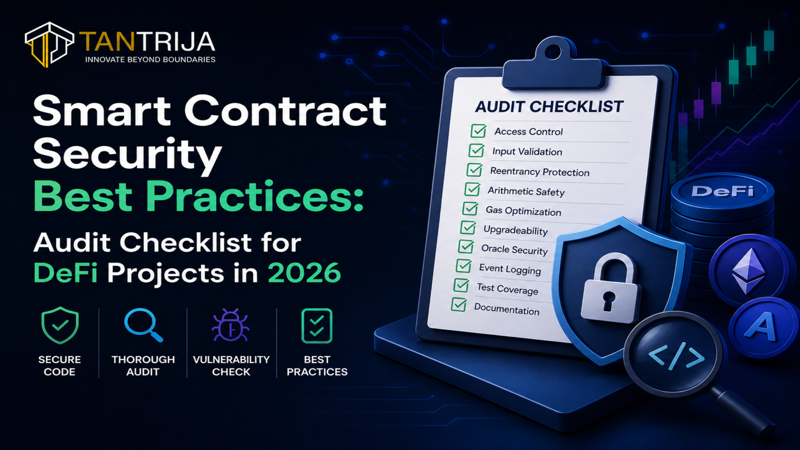
Smart Contract Security Best Practices Checklist
Development Phase
Use Solidity 0.8+ and lock the pragma version
Follow Checks-Effects-Interactions pattern in every state-changing function
Apply OpenZeppelin's battle-tested libraries (ERC-20, ERC -721, AccessControl, ReentrancyGuard)
Write comprehensive NatSpec documentation for all functions and events
Use immutable and constant for values that never change to save gas and prevent mutation
Emit events for every state change -critical for monitoring and incident response
Design upgrade mechanisms (transparent proxy or UUPS) if post-launch changes may be needed
Testing Phase
Achieve 100% line coverage and 100% branch coverage in unit tests
Write fuzz tests using Foundry's fuzzer or Echidna for arithmetic and boundary conditions
Conduct integration tests that simulate realistic economic scenarios including flash loan sequences
Use Slither (static analysis) and Mythril (symbolic execution) for automated vulnerability detection
Test on a forked mainnet using Hardhat or Foundry to interact with live protocol state
Pre-Audit Phase
Complete internal review by a developer who did not write the code
Fix all issues identified by automated tools before audit submission
Provide auditors with a threat model, known attack vectors, and architectural documentation
Post-Audit Phase
Resolve all Critical and High severity findings before mainnet deployment—no exceptions. This is a core requirement in Blockchain Audit Services to ensure the protocol is secure before going live.
Publish the audit report publicly to improve transparency and build community trust.
Set up a bug bounty program through platforms like Immunefi or HackerOne before launch to identify additional vulnerabilities.
Deploy an on-chain monitoring solution such as Forta or OpenZeppelin Defender for real-time anomaly detection.
Establish an incident response plan and implement a multisig-controlled emergency pause function to quickly mitigate potential threats.
How to Choose a Smart Contract Audit Firm
Specialization matters: Choose a firm that audits specifically for your chain and protocol type. A firm specializing in Solidity/EVM is the right choice for Ethereum DeFi, while Solana protocols require Rust/SVM expertise.
Review past reports: Top firms like Trail of Bits, Consensys Diligence, Spearbit, and Sherlock publish their past audit reports. Reading several helps you understand the depth and rigor of their methodology.
Timeline: A serious audit typically takes 2- 4 weeks for a mid-complexity protocol. Be cautious of firms promising comprehensive audits in just 3 -5 days.
Competitive audit platforms: Platforms like Sherlock, Code4rena, and Cantina offer competitive audits where multiple independent security researchers review your code simultaneously, often uncovering more issues than a single firm.
Tantrija's Smart Contract Audit Services
Tantrija provides pre-audit security review and hardening services, helping DeFi protocols and Web3 projects remediate common vulnerabilities before formal audit submission. Our blockchain audit services cover smart contract code review, automated tool analysis, manual vulnerability assessment, and coordination with leading audit firms. We also assist with post-audit remediation and bug bounty program setup.
Conclusion
Smart contract security is not a checkbox-it is an ongoing discipline that must be embedded into every phase of your development process. Following the best practices in this checklist, commissioning a professional audit, and maintaining active post-launch monitoring are the minimum requirements for any DeFi project that handles real user funds. The cost of an audit is a fraction of the cost of an exploit.