
Flutter has grown from a Google experiment to one of the most popular cross-platform mobile frameworks in the world. Today, over 1 million published apps use Flutter - from small startups launching their first MVP to Fortune 500 companies modernizing legacy mobile products.
The reason is simple: Flutter delivers near-native performance from a single Dart codebase that runs seamlessly on iOS, Android, Web, and Desktop.
If you’re evaluating Flutter for your next app - or comparing it with React Native - this guide provides a clear breakdown of cost, timeline, and what to expect from a professional development process.
What Makes Flutter Different from Other Frameworks?
Most cross-platform frameworks either compile to native components or rely on a JavaScript bridge to communicate with the native layer. Flutter, however, follows a completely different approach.
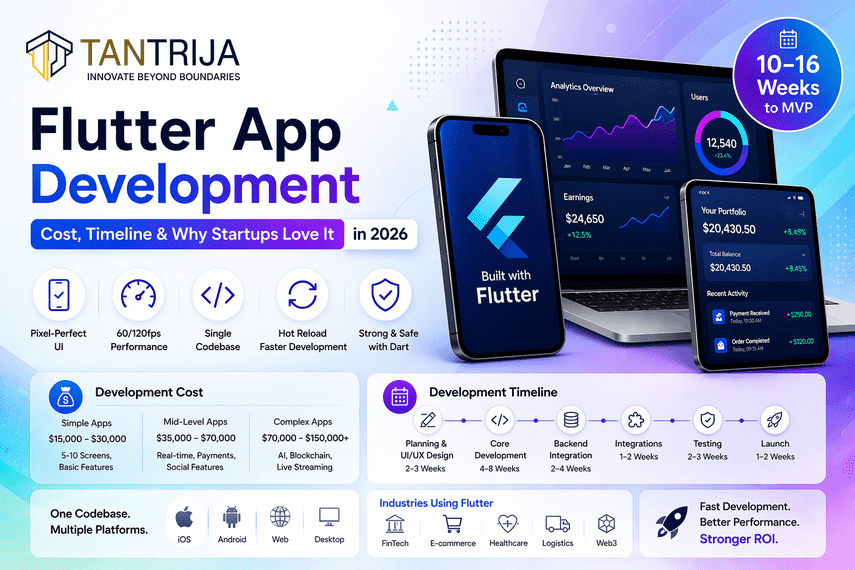
In Flutter App Development, the framework uses its own rendering engine (Skia / Impeller) to draw every pixel on the screen, instead of depending on native UI components. This architecture UI that looks identical across iOS and Android, delivers smooth 60fps (or even 120fps) animations without JavaScript bridge lag, and enables a single codebase for mobile, web, and desktop platforms.
It also offers hot reload for faster development and instant UI updates, along with strong type safety through Dart, which helps reduce runtime errors. This combination of performance, flexibility, and efficiency is what truly sets Flutter apart.
Flutter vs React Native: Which Should You Choose?
Choosing between Flutter and React Native depends on your project needs and team expertise.
Flutter is ideal when UI consistency across platforms is critical, when your application requires complex animations or custom UI components, when you want a single team managing one codebase, or when you plan to target both mobile and web from the beginning.
On the other hand, React Native is a better fit if your team has strong experience in JavaScript or TypeScript, if your project depends on specific native libraries not available in Flutter, or if your app heavily relies on platform-native UI conventions.
For most modern, consumer-focused applications, Flutter is often the more practical choice due to its mature ecosystem and strong support from Google.
Flutter App Development Cost Breakdown
The cost of Flutter app development varies based on complexity. A simple application with basic features and limited screens typically ranges from $15,000 to $30,000. Mid-level applications with real-time data, payments, and social features can cost between $35,000 and $70,000. More complex applications that include AI, blockchain, or live streaming features can exceed $70,000 and go beyond $150,000.
Several factors influence the overall cost, including backend complexity, the number of API integrations, real-time functionality such as Firebase or WebSockets, third-party SDKs like payment gateways or analytics tools, custom UI and animation requirements, and ongoing post-launch support.
Flutter App Development Timeline
The timeline for developing a Flutter app depends on the project scope. Typically, the planning and UI/UX design phase takes around 2 to 3 weeks, followed by core development which may take 4 to 8 weeks. Backend integration usually requires 2 to 4 weeks, while third-party integrations take an additional 1 to 2 weeks.
Testing, including unit, widget, and integration testing, generally takes 2 to 3 weeks. Finally, app store submission and approval can take 1 to 2 weeks. Overall, a standard MVP can be built within 10 to 16 weeks depending on complexity and team efficiency.
Flutter Tech Stack
Flutter uses a modern and flexible tech stack. For state management, developers commonly use Riverpod, BLoC, or Provider. Navigation is handled efficiently with GoRouter. For backend services, Firebase is often used for rapid development, while Node.js with PostgreSQL is preferred for scalable, production-grade applications.
Local storage options include Hive for lightweight data and SQLite (via Drift) for structured data. Networking is typically managed using Dio or the HTTP package, and testing is done using flutter_test, integration_test, and mockito.
Industries Using Flutter in Production
Flutter is widely used across multiple industries. In FinTech, it powers banking apps, digital wallets, and investment platforms. In e-commerce, it is used for marketplaces and retail applications. Healthcare applications include telemedicine platforms and health tracking systems.
Logistics companies use Flutter for delivery tracking and driver management apps, while in Web3, it supports NFT wallets, decentralized applications, and blockchain dashboards.
Why Choose Tantrija for Flutter Development
Tantrija’s Flutter development team has delivered production-ready applications across startups, enterprises, and Web3 platforms. Their services cover end-to-end app development, including design, development, testing, and deployment.
They also specialize in building custom UI component libraries, implementing scalable architectures, and providing ongoing feature development and support. Their focus on clean architecture ensures that the codebase remains maintainable and easy to extend for future growth.
Conclusion
Flutter stands out as one of the best choices for cross-platform development. Its performance, flexibility, and developer-friendly ecosystem make it ideal for building modern applications without the need to maintain multiple codebases.
Whether you are launching a new MVP or upgrading an existing product, partnering with an experienced Flutter app development company can help you deliver faster while maintaining high quality.