
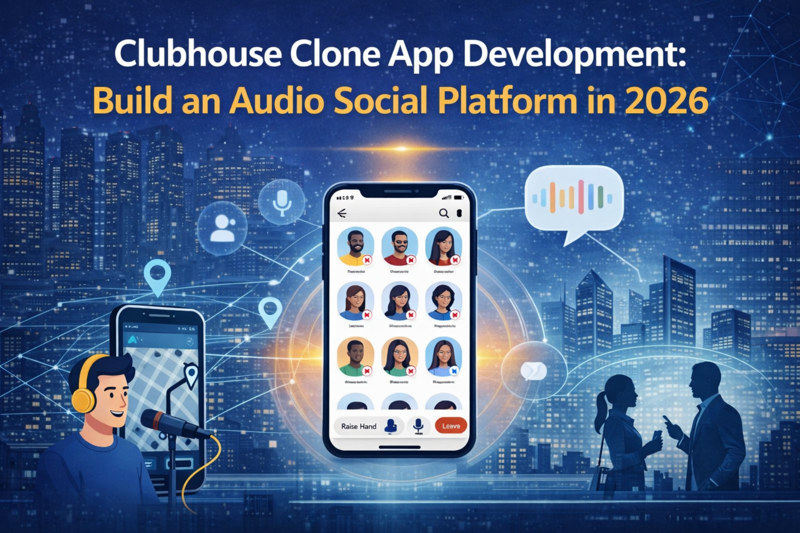
The audio social networking space exploded with Clubhouse's meteoric rise, and while the original app has matured, the demand for niche audio communities remains stronger than ever in 2026. Businesses, creators, and entrepreneurs are actively investing in Clubhouse clone app development to build fully owned, branded audio platforms tailored to specific audiences - from finance and gaming to education and creator communities.
Building a Clubhouse clone from scratch requires careful planning around real-time audio infrastructure, room management, user roles, and long-term scalability. This guide covers everything you need to know before starting your development journey.
What Is a Clubhouse Clone App?
A Clubhouse clone app is a live audio social networking application that replicates the core functionality of Clubhouse - real-time voice chat rooms, speaker and listener roles, and a social discovery feed. Unlike a white-label script, a properly built Clubhouse clone app is developed from the ground up using WebRTC or advanced audio SDKs, giving you full control over performance, data ownership, monetization models, and feature customization.
Today, audio-first platforms are widely used across professional networking, fan communities, and creator ecosystems. The format drives significantly higher engagement compared to text-based platforms, making it one of the most compelling product categories to build in 2026.
Core Features of a Clubhouse Clone App
MVP Features
A solid MVP focuses on the features that make audio social networking work. These include:
- Live Audio Rooms - Real-time voice streaming with minimal latency
- Speaker / Listener / Moderator Roles - Structured stage management for organized conversations
- Raise Hand & Stage Management - Audience-to-speaker flow control
- Room Discovery Feed - Personalized content surfacing for users
- User Profiles & Follow System - Social graph building
- Push Notifications - Engagement and re-activation triggers
- Room Scheduling & Calendar Integration - Planned events and recurring sessions
Advanced Features
Once the MVP is live and validated, platforms typically expand with capabilities that drive monetization and retention:
- Recording & Replay - Asynchronous content consumption for missed sessions
- Monetization Tools - Subscriptions, tipping, and paid room access
- AI-Powered Summaries & Transcripts - Automated post-session content generation
- Content Moderation System - Safety and community health tools
- Analytics Dashboard - Host and admin performance insights
Tech Stack for Clubhouse Clone Development (2026)
Choosing the right technology stack is one of the most critical decisions in building a scalable audio platform. The stack must support real-time communication, handle concurrent users efficiently, and remain maintainable as you scale.
Real-Time Audio is the backbone of any audio social platform. Leading options in 2026 include Agora.io, Twilio, and Daily.co SDK - each offering low-latency audio streaming with SDKs for mobile and web.
Backend infrastructure typically runs on Node.js or Go with WebSocket support for real-time sync, paired with Redis Pub/Sub for event broadcasting across distributed services.
Databases follow a layered approach: PostgreSQL handles core relational data (users, rooms, social graph), Redis manages session caching and presence, and Elasticsearch powers search and content discovery.
Mobile development is best handled with React Native for cross-platform iOS and Android delivery, with native audio modules integrated for performance-critical voice features.
Cloud and notifications round out the stack - AWS EC2 with auto-scaling, CloudFront CDN, and Amazon S3 for media storage, with Firebase Cloud Messaging and Apple Push Notification Service handling user notifications.
Clubhouse Clone App Development Cost
Development costs scale significantly based on feature depth, team location, and infrastructure requirements. Here's a general breakdown:
- Basic MVP: $25,000 – $50,000
- Full-Featured Product: $60,000 – $120,000
- Enterprise-Grade AI Platform: $120,000+
Beyond development, plan for ongoing operational costs including audio SDK usage fees (typically $0.001–$0.005 per minute per user), cloud hosting, and maintenance. These costs scale directly with your user growth and audio consumption volume - a factor worth modeling early in your business planning.
Why Audio-First Platforms Are Growing in 2026
Audio-based platforms continue to gain traction for a combination of behavioral and technological reasons. Consumption of live audio and podcasts has grown consistently year over year, and the format carries a low cognitive load compared to video - making it ideal for multitasking during commutes, workouts, or work.
Niche communities benefit especially from audio-first formats. Industries like Web3, finance, healthcare, and education are increasingly using audio rooms for webinars, community building, and live engagement - replacing or supplementing traditional video conferences with more accessible, lower-friction alternatives.
For platform builders, this translates into strong retention metrics, high session duration, and loyal community formation - particularly when the platform is focused on a vertical rather than built for general audiences.
How Tantrija Helps You Build a Clubhouse Clone
Tantrija specializes in building scalable, real-time audio social platforms using modern technologies, including Agora SDK, WebRTC, and cloud-native architecture. Rather than adapting generic templates, we architect each platform from the ground up to match your specific community and monetization goals.
Our delivery includes end-to-end Clubhouse clone app development, custom moderator and community tools, white-label UI/UX solutions, and a scalable backend designed for growth. We offer flexible engagement models - fixed-price MVP development for early-stage products, and dedicated development teams for ongoing platform evolution.
Final Thoughts
Building a Clubhouse clone app in 2026 is technically complex but highly achievable with the right strategy and technology stack. Success depends on strong execution in three core areas: real-time audio performance, social graph systems, and infrastructure that scales with your community.
With increasing demand for niche audio communities across industries, the window to build and establish a platform is open right now. Tantrija can help you bring your audio social networking vision to life in under five months.