
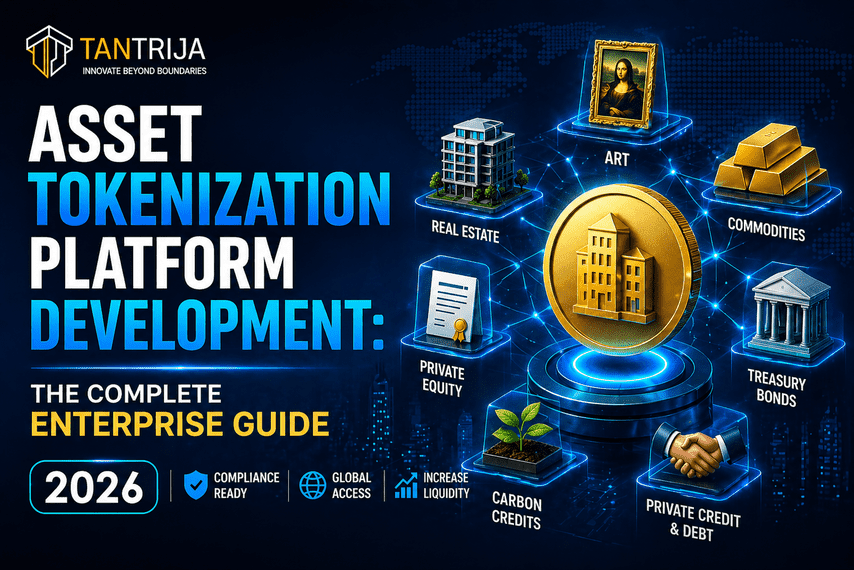
Real World Asset (RWA) tokenization is changing how enterprises approach capital markets, ownership, and liquidity. By turning physical or financial assets - such as real estate, private equity, commodities, art, and treasury bonds - into blockchain-based tokens, organizations can enable fractional ownership, round-the-clock trading, programmable compliance, and access to global investors without the usual friction of traditional systems.
In 2026, major institutional players like BlackRock and JPMorgan have already tokenized billions in assets. The ecosystem is evolving quickly, regulations are becoming clearer in key regions, and the demand for enterprise-grade tokenization platforms is growing fast. This guide walks through what it takes to build a production-ready asset tokenization platform.
What Is Asset Tokenization?
Asset tokenization is the process of converting ownership rights of a real-world asset into a digital token on a blockchain. Each token represents either a full or fractional share of the asset. Because these tokens exist on a blockchain, they are programmable, divisible, transferable, and easy to audit. This concept is often referred to as Real-World Asset Tokenization, highlighting the connection between physical assets and digital finance.
For example, a commercial property worth $10 million can be divided into 10 million tokens priced at $1 each. Investors from anywhere in the world can buy these tokens, earn proportional income such as rent, and trade them on secondary markets without relying on traditional intermediaries or dealing with paperwork and location barriers.
Types of Assets Being Tokenized
Real estate includes commercial buildings, REITs, development projects, and rental portfolios that can be fractionalized for global investors.
Private credit and debt cover SME loans, trade finance, and invoice factoring, allowing more efficient capital flow and broader participation.
Commodities such as gold, silver, oil, and agricultural goods can be tokenized to enable easier trading and ownership distribution.
Private equity involves venture capital funds, company shares, and revenue-based financing models, making traditionally illiquid assets more accessible.
Treasury and government bonds include instruments like US T-bills and sovereign debt, which can benefit from improved transparency and efficiency through tokenization.
Art and collectibles include fine art, luxury goods, and sports memorabilia, offering new ways for investors to own fractional shares of high-value items.
Carbon credits represent environmental offset instruments and are gaining traction as tokenization helps improve traceability and market access.
Core Architecture of an Asset Tokenization Platform
Legal and Compliance Foundation
Before any blockchain development begins, organizations need to establish a strong legal structure. This is usually done through a Special Purpose Vehicle (SPV) that legally holds the asset. It also involves working with custodians and ensuring compliance with regulations. Smart contracts are then designed to enforce rules automatically, such as allowing only verified investors to participate or applying lock-in periods.
Smart Contract Architecture
This is the core technical layer of the platform. It defines how tokens are created, managed, and transferred. Standards like ERC-3643 (T-REX), ERC-1400, and ERC-1404 are commonly used because they support compliance features like KYC verification and transfer restrictions. The system also includes identity registries, validation mechanisms for transactions, automated dividend distribution, and recovery options for regulatory needs.
Investor Portal and Onboarding
This layer focuses on the user experience for investors. It includes onboarding, identity verification, and compliance checks such as KYC and AML. Investors can register, verify their identity, connect payment methods, invest in assets, and manage their wallets. Many platforms offer both custodial and self-custody wallet options depending on user preference.
Asset Management Dashboard
This section is designed for asset issuers to manage operations efficiently. It allows them to handle cap tables, schedule payouts, generate reports, track compliance, and monitor activity. A well-built dashboard reduces manual work and improves overall efficiency compared to traditional systems.
Secondary Market (Optional)
Some platforms include a secondary market where investors can trade tokenized assets. This may involve integration with regulated trading systems or exchanges. The presence of a secondary market improves liquidity, making tokens more flexible and valuable compared to static digital holdings.
Blockchain Selection for Tokenization Platforms
Ethereum is widely used due to strong liquidity and ecosystem support, though it comes with higher transaction costs.
Polygon offers lower fees and strong compatibility, making it a popular choice for many use cases.
Avalanche provides subnet capabilities for private, compliance-focused deployments.
Private or permissioned chains such as Hyperledger are used when full control over data visibility is required.
Compliance and Regulatory Considerations
KYC and AML checks are required during onboarding and beyond. Platforms must comply with securities laws such as Reg D, Reg S, and Reg A+ in the US, MiFID II in the EU, and FSMA in the UK. Data privacy regulations like GDPR must also be followed, with sensitive data stored off-chain.
Systems should support requirements like the Travel Rule for large transactions and adapt to evolving frameworks such as MiCA.
Development Timeline and Cost
MVP Development
A basic platform with a single asset class and limited features typically takes 16 to 22 weeks and costs between $80,000 and $150,000.
Full Platform Development
A complete platform with multiple asset classes, advanced compliance automation, and secondary trading capabilities can take 30 to 52 weeks and cost $200,000 to $500,000 or more.
Factors like regulatory jurisdiction and integration complexity have a major impact on both time and budget.
Why Choose Tantrija for Asset Tokenization Platform Development
Tantrija provides end-to-end asset tokenization development services, covering everything from smart contract architecture using ERC-3643 to investor portal design, compliance integration, and issuer dashboard development.
With experience in real estate and private credit tokenization, the team combines deep blockchain expertise with a strong understanding of regulatory requirements to deliver production-ready platforms.