
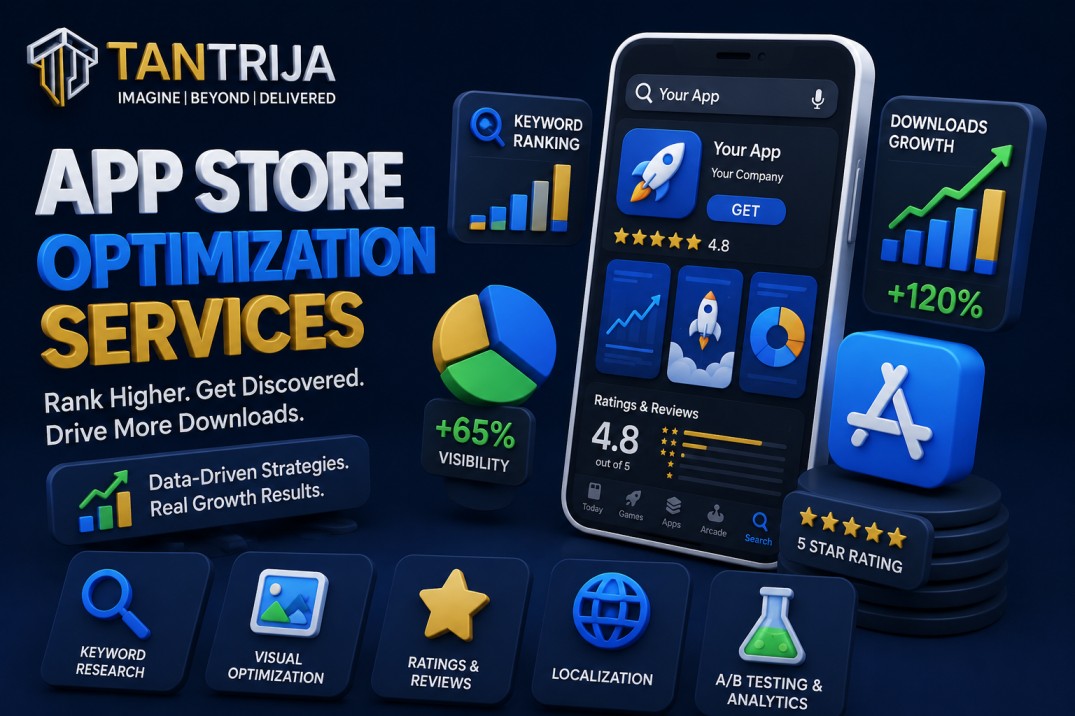
There are over 5.5 million apps across the App Store and Google Play. The average user discovers 40% of new apps through app store search -making ASO (App Store Optimization) the single most important organic growth channel for mobile apps. Yet most app developers treat ASO as an afterthought, spending months on development and hours on metadata.
Effective ASO in 2026 is a data-driven, iterative discipline that encompasses keyword strategy, visual conversion optimization, ratings management, localization, and ongoing testing. Businesses investing in professional app store optimization services can significantly improve app visibility, attract high-intent users, and maximize download growth. This guide covers everything you need to rank higher and convert more impressions into downloads
ASO vs SEO: Understanding the Difference
ASO and SEO share the same fundamental goal -rank for relevant search queries and convert traffic to action -but the algorithms, signals, and tactics differ significantly. App store search algorithms prioritize keyword relevance (in title, subtitle, keyword field), download velocity, ratings and reviews, conversion rate (impression-to-download), and engagement signals (sessions, retention) rather than backlinks and domain authority.
Key distinction: In SEO, rankings are primarily influenced by authority signals (links). In ASO, rankings are primarily influenced by conversion and engagement signals. An app that converts impressions to downloads at 40% will outrank an app converting at 10%, even if the lower-converting app has more downloads historically.
Keyword Research for ASO
App Store vs Google Play Keyword Architecture
App Store (iOS): Uses a dedicated keyword field (100 characters) that does not display to users, plus the app title (30 characters) and subtitle (30 characters). Keywords in the title carry the most weight. The keyword field should contain unique keywords not already present in the title or subtitle -Apple ignores duplicates.
Google Play: Uses the full app description (4,000 characters) for indexing -there is no separate keyword field. Google's algorithm reads the description and indexes it similarly to web page content. Keyword density and natural placement across the description matter significantly.
Finding the Right Keywords
Finding the right keywords is the foundation of a successful ASO strategy. Start by analyzing competitors with tools like AppFollow, AppTweak, or Sensor Tower to identify the keywords driving traffic to top-performing apps in your category. Focus on high-volume, medium-competition keywords and long-tail search phrases that have clear user intent but face less competition. Reviewing competitor ratings and user feedback can also reveal the language your target audience uses when describing app benefits. Additionally, targeting relevant branded competitor keywords can help attract users who are actively looking for alternative solutions.
Optimizing Your App Title & Subtitle
The app title is the single highest-weighted ASO element. Every word in the title is indexed and given maximum keyword weight. Best practices:
Your app title and subtitle are among the most important elements of App Store Optimization because they carry significant weight in app store search rankings. The title should begin with your brand name and include your primary target keyword in a natural, readable way to improve discoverability without harming user trust. The subtitle on the App Store or short description on Google Play should then focus on a secondary keyword group that supports your core offering. Avoid unnecessary punctuation, symbols, or keyword stuffing, as these can reduce readability and negatively impact conversion rates. A clear, keyword-rich, and brand-friendly title strategy helps improve both rankings and download performance.
Visual Optimization: Screenshots & App Preview Video
App store search returns a list of results with only the icon, app name, and first two screenshots visible without scrolling. These three elements -not your feature list or reviews -determine whether a user taps to learn more. The first screenshot must communicate your app's core value proposition in a single glance.
Screenshot Best Practices
App screenshots play a major role in converting store visitors into downloads, making visual optimization a key part of ASO. The first screenshot should highlight your app’s most compelling feature, accompanied by a short benefit-focused caption that clearly communicates value to users. Maintaining a consistent visual style across all screenshots, including colors, typography, and device frames, creates a professional and trustworthy appearance. Additionally, testing different screenshot layouts, such as portrait and landscape orientations, can help identify which format drives higher engagement and conversion rates, especially on Google Play where landscape screenshots often receive prominent placement.
App Preview Video
An app preview video (App Store) or promo video (Google Play) can increase conversion rate by 25–30% when done well. The video must show the actual app UI -not animations or lifestyle footage -within the first 3 seconds. Video autoplays silently in search results, so motion alone must convey the app's value without audio.
Ratings & Reviews Strategy
App store algorithms use ratings (star score and volume) as a strong ranking signal. Apps below 4.0 stars see significantly reduced visibility. Apps above 4.7 stars with high review volume outraok provide me it in 2 small pagaph
Ratings and reviews are one of the most important App Store Optimization (ASO) factors because app store algorithms consider both star ratings and review volume when determining rankings. Apps with ratings below 4.0 stars often struggle to gain visibility, while apps maintaining ratings above 4.7 stars with a healthy number of reviews typically achieve better rankings and attract more organic downloads. Using in-app rating prompts through the native SKStoreReviewRequest API at the right moments, such as after a successful action or completed goal, can help encourage positive user feedback.
Managing reviews is equally important for long-term app growth. Businesses should respond to negative reviews within 24 hours whenever possible, as timely responses can improve user trust and increase the likelihood of rating updates. Developers should also avoid incentivizing reviews, as this violates App Store guidelines. Additionally, monitoring review sentiment with tools like AppFollow or Appbot helps identify user concerns early, enabling teams to improve the app experience, strengthen their reputation, and maintain higher app store rankings.
A/B Testing for ASO
App Store Product Page Optimization: Apple's native A/B testing allows testing up to 3 variants of icon, screenshots, and preview video. Run tests for at least 90 days to achieve statistical significance -faster test cycles produce unreliable results due to day-of-week seasonality.
Google Play Store Listing Experiments: Test different icons, feature graphics, screenshots, and short descriptions. Google reports statistical significance directly in the console, making it easier to identify winning variants.
Localization: The Underutilized ASO Lever
Localizing your app store listing into additional languages is one of the highest-ROI ASO investments. Each language targets a distinct search index -localizing into Japanese, Portuguese, Spanish, and German gives you four additional ranking opportunities with relatively low incremental effort. Keyword research must be conducted in each target language independently -translated keywords do not map directly to high-volume local search terms.
Tantrija's App Store Optimization Services
Tantrija provides data-driven app store optimization services covering full keyword audits and strategy, title/subtitle/description rewriting, screenshot and preview video production, A/B testing setup and monitoring, review management strategy, and localization coordination. We work with apps at all stages -from pre-launch metadata setup to mature apps looking to recover lost ranking ground.
Conclusion
App Store Optimization is not a one-time task -it is an ongoing discipline that requires regular keyword updates as the competitive landscape shifts, continuous visual conversion testing, and active review management. Apps that treat ASO as a growth channel -not a launch checklist -consistently outperform their category competitors in organic download volume. Start with a full ASO audit of your current metadata, identify your highest-opportunity keywords, and test one variable at a time.