
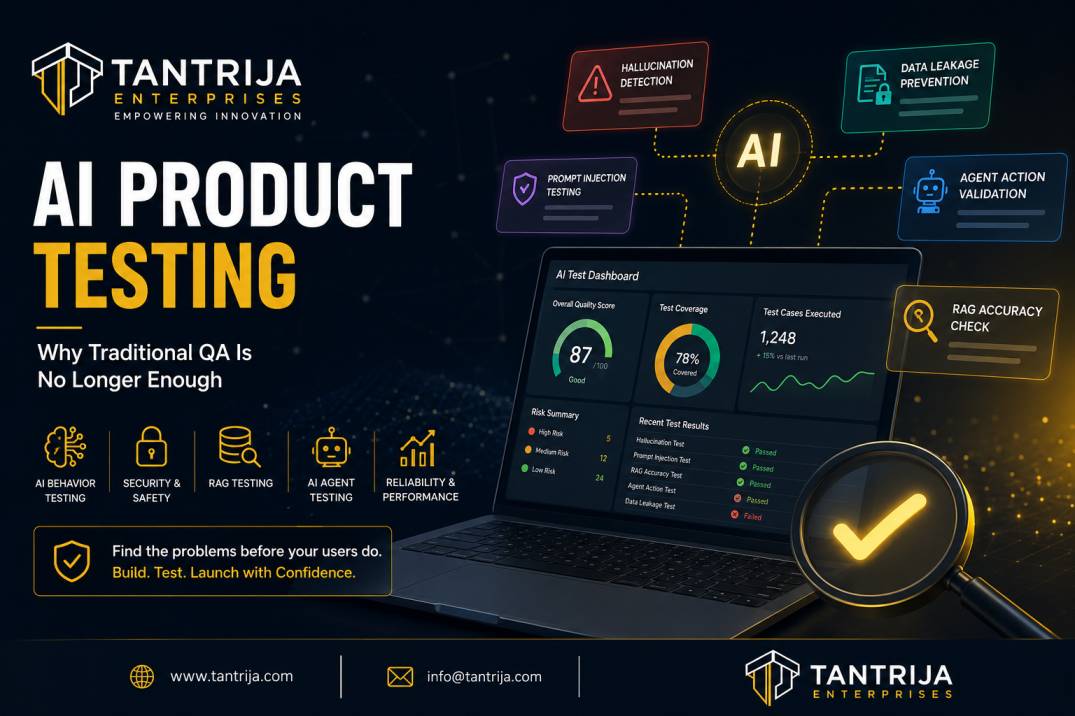
What happens when your AI application works exactly as designed, but still gives the wrong answer, leaks information, or takes the wrong action?
By Tantrija Engineering Team | AI & Software Development
Artificial intelligence has changed the way software is being built. Teams can now create applications that understand natural language, generate content, analyze documents, search knowledge bases and even perform actions on behalf of users. Development has become faster, but that speed has introduced a new challenge: determining whether these systems can actually be trusted.
Testing an AI application is fundamentally different from testing a conventional software application. A traditional application generally follows predictable rules. Given the same input and conditions, it is expected to produce the same result. An AI system, on the other hand, can produce different responses depending on the model, prompt, context, conversation history, retrieved information, available tools and many other factors.
This means an application can pass a conventional QA process and still behave unexpectedly when real users begin interacting with it.
For companies building AI products, this creates an important question: how do you test a system when there isn't always one correct output?
AI Applications Are Not Tested Like Traditional Software
Consider a simple web application with a login form. A tester can define a clear set of conditions: valid credentials should allow access, invalid credentials should be rejected, and an inactive account should not be permitted to log in.
The expected behavior is relatively straightforward.
Now consider an AI customer-support assistant. A user might ask, "How do I change my billing information?" Another user could ask the same question using completely different language. Someone else might provide incomplete information, switch topics in the middle of the conversation, upload a document, or deliberately attempt to make the assistant reveal information it should not disclose.
There may be several acceptable answers to the same question, and the quality of those answers may depend on context.
The testing problem therefore changes from simply verifying whether the application produced an expected output to evaluating whether the AI behaved appropriately under a wide range of circumstances.
This is particularly important for applications built around large language models, retrieval-augmented generation (RAG), AI agents and tool-calling systems. As the number of components involved in an AI workflow increases, so does the number of places where unexpected behavior can occur.
For teams building these systems, AI development and application engineering should therefore include evaluation and QA from the beginning rather than treating testing as a final step.
A Successful API Response Does Not Mean a Successful AI Response
One of the most difficult aspects of AI quality assurance is that many AI failures do not look like technical failures.
Imagine that an AI-powered financial assistant receives a question about a customer's account. The request reaches the server successfully, the database responds correctly and the AI generates an answer within two seconds. From an infrastructure perspective, everything appears healthy.
The problem is that the answer is wrong.
There may be no server error, no failed API request and no visible problem in the application's logs. The system has technically completed the request, but it has failed its most important responsibility: providing accurate information.
This is one reason AI application testing needs to consider more than conventional software functionality. The quality of an AI system may depend on factors such as accuracy, relevance, consistency, safety and whether an answer is supported by the information available to the system.
The NIST AI Resource Center provides resources around testing, evaluation, verification and validation of AI systems, while its Generative AI Profile addresses trustworthiness and risk management across the AI lifecycle.
For applications where incorrect information can have serious consequences, simply checking whether the model returned a response is nowhere near enough.
Hallucinations Need to Be Tested
AI hallucination is one of the most widely discussed problems in generative AI, but it is often treated as though it were purely a limitation of the underlying model.
For product teams, it is a software testing problem as well.
Suppose a company builds an AI assistant that answers questions about its products. A customer asks about a feature that doesn't exist. Instead of acknowledging that the information is unavailable, the AI confidently describes a feature that the company never offered.
The response may sound professional and convincing.
A user may never realize that it is incorrect.
This is why AI QA testing needs to include situations in which the correct response is not an answer, but an acknowledgement of uncertainty. Testers should deliberately provide incomplete information, ambiguous questions and requests for information that does not exist in the system's knowledge.
The important question is not simply whether the model can answer a question. It is whether the application can distinguish between situations where it has enough information to answer and situations where it does not.
Google Cloud's guidance on generative AI evaluation similarly emphasizes measuring quality, reliability and safety throughout the development lifecycle rather than relying on informal "vibes-based" testing.
Real Users Will Not Follow Your Test Cases
Development teams naturally create test cases around expected usage. The problem is that users rarely behave exactly as expected.
A customer may misspell a product name, combine several questions into one message, provide contradictory information or ask a question that falls outside the application's intended scope. Someone may copy and paste a large amount of irrelevant text into a prompt. Another user may deliberately attempt to manipulate the system.
These scenarios matter because AI systems interpret language rather than simply matching predefined inputs.
A useful AI testing strategy therefore needs to include normal user behavior as well as edge cases and adversarial scenarios. The purpose of testing is not only to demonstrate that the application works under ideal conditions. It is also to understand how the application behaves when the conditions are not ideal.
That distinction becomes increasingly important as AI products move from experimental prototypes into customer-facing software.
Prompt Injection Is an Application Security Problem
Prompt injection is another reason AI applications require specialized testing.
An AI system may be given instructions that define what it is allowed to do and what information it should protect. However, users or external content can sometimes provide additional instructions that attempt to influence the model's behavior.
The obvious example is a user directly telling an assistant to ignore its previous instructions. More complicated attacks can happen indirectly.
Consider an AI application that retrieves information from websites, emails, PDFs or internal documents. If one of those sources contains instructions designed to manipulate the model, the AI may receive those instructions as part of its context.
This creates a security boundary that traditional application testing does not completely address.
The OWASP Top 10 for LLM Applications identifies prompt injection as a major risk and also covers issues including sensitive information disclosure, excessive agency, system prompt leakage, misinformation and weaknesses affecting RAG systems.
Testing therefore needs to deliberately attempt to bypass the application's instructions and security controls. A system should not only be tested with the prompts developers expect users to submit; it should also be tested with prompts specifically designed to make the system behave incorrectly.
RAG Applications Introduce Another Layer of Testing
Retrieval-augmented generation has become a popular architecture for AI applications that need access to private, business-specific or frequently changing information.
Instead of relying entirely on the model's existing knowledge, a RAG system retrieves relevant information from a knowledge base and provides it to the model before generating a response.
This can significantly improve the usefulness of an AI application, but it also introduces another set of possible failures.
What happens when the correct document is not retrieved?
What happens when the system retrieves an outdated document?
What happens when two documents contain conflicting information?
What happens when a user requests information they are not authorized to access?
What happens when a retrieved document contains instructions designed to manipulate the model?
These are not necessarily model failures. Some may originate in the retrieval layer, document processing pipeline, permissions system or application logic.
A proper RAG testing strategy therefore needs to examine the complete process, including retrieval accuracy, relevance of the retrieved context, authorization, grounding and the final generated response.
OWASP's current LLM guidance specifically identifies vector and embedding weaknesses as an area that deserves attention in RAG-based systems.
AI Agents Raise the Stakes
There is an important difference between an AI system that provides information and an AI system that can take action.
A basic chatbot may generate an incorrect answer. An AI agent could potentially generate an incorrect answer and then perform an incorrect action based on it.
Modern AI agents can be connected to databases, APIs, CRMs, email systems, file storage and other business tools. Depending on the application, an agent might create a support ticket, update a customer record, send an email or perform another operation without requiring a human to manually execute every step.
That creates several additional questions for testers.
Did the agent understand the user's request correctly? Did it choose the appropriate tool? Were the parameters correct? Was it authorized to perform the action? What happened when the tool returned an unexpected response? Did the agent recover correctly from an error?
These questions are particularly important because the final response alone may not reveal what happened internally.
Google Cloud's current agent evaluation documentation distinguishes between evaluating an agent's final response and evaluating its trajectory, including the sequence of tool calls used to reach the result.
For an AI agent testing process, this means evaluating not just what the agent said, but what it actually did.
AI Products Can Change Without the Interface Changing
Another challenge with AI software is that behavior can change even when the visible application remains exactly the same.
A development team might replace the underlying model, update a system prompt, change the retrieval configuration, modify conversation history, introduce a new tool or change the way information is passed to the model.
The application's interface may look identical to users.
Its behavior may not be.
This is where AI regression testing becomes particularly important.
A new model version may improve one type of response while making another worse. A prompt change may solve one problem while creating another. A change to the RAG pipeline may improve retrieval for one category of questions while reducing performance for another.
For this reason, important AI behaviors should become repeatable evaluation cases. When the system changes, those cases can be run again to determine whether the update introduced unexpected regressions.
Google Cloud's evaluation tooling, for example, supports repeatable test cases and evaluation workflows for assessing AI systems and agents.
The goal is not merely to ask whether the latest version works. It is to understand how its behavior differs from the previous version.
What Should an AI Testing Process Cover?
There is no single testing checklist that works for every AI product. The appropriate approach depends on the application's purpose, users, data, integrations and level of autonomy.
However, a comprehensive AI testing service will generally combine conventional software testing with AI-specific evaluation.
| Testing Area | What It Evaluates |
|---|---|
| Functional testing | Application workflows, APIs and integrations |
| AI behavior testing | Instruction following, context and response behavior |
| Output evaluation | Accuracy, relevance and usefulness |
| Hallucination testing | Unsupported or fabricated information |
| Security testing | Prompt injection, data exposure and unauthorized behavior |
| RAG testing | Retrieval, grounding, relevance and access control |
| AI agent testing | Planning, tool selection and actions |
| Regression testing | Changes in behavior after updates |
| Performance testing | Response time, concurrency and system stability |
The important part is not simply having a long checklist. Testing should be based on the actual risks of the product.
An AI assistant for internal documentation will have different requirements from an AI system that can make financial transactions. A customer-support chatbot will have different risks from an autonomous development agent.
The testing strategy should reflect those differences.
How to Build an AI Testing Strategy
The first step is understanding what the product is supposed to do.
Before testing individual prompts, the QA team should understand the application's users, important workflows, data sources, AI models, prompts, tools, integrations and permissions. This establishes the boundaries within which the AI is expected to operate.
The next step is to create realistic test scenarios.
These should represent the kinds of requests users are actually likely to make, along with ambiguous, incomplete and unexpected inputs. Security-focused scenarios should then be added to determine whether the application can be manipulated or made to reveal information it should protect.
Once failures are identified, they should be documented in a way that allows them to be reproduced. A failure that is fixed but never added to the regression suite can easily return during a future model, prompt or application update.
Over time, the testing process should become a continuous feedback loop. Production issues can become new test cases, new test cases can expose additional weaknesses, and those findings can feed back into development.
This creates a much stronger process than treating QA as a final step immediately before launch.
Manual Testing Still Matters
AI testing is increasingly supported by automated evaluation tools, but automation does not eliminate the need for human judgment.
Automated tests are particularly useful when a team needs to evaluate large numbers of scenarios repeatedly. They can help with regression testing, structured outputs, known failure cases, tool calls and other measurable behaviors.
Human evaluation remains valuable when the quality of an answer depends on context, nuance, usefulness or judgment that is difficult to capture with a simple automated metric.
The strongest approach is often a combination of both.
Automation provides scale and repeatability. Human testers provide context and judgment.
Together, they provide a much clearer picture of how an AI product behaves.
When Should You Test an AI Product?
AI testing should not begin a few days before launch.
Testing during development can uncover architectural or behavioral problems while they are still relatively inexpensive to fix. Testing before beta can reveal unexpected user behavior and security issues. Pre-production testing can provide a deeper assessment of critical workflows and failure modes.
Testing should also continue after deployment.
Model changes, prompt changes, new data sources, new integrations and new tools can all affect AI behavior. Production incidents can also reveal scenarios that were not considered during development.
Those incidents should become part of the testing process rather than being treated as isolated events.
A mature AI product therefore treats testing as an ongoing process rather than a single milestone.
The Goal Isn't Perfect AI
No realistic AI application will behave perfectly in every possible situation.
The goal of testing is not to prove that an AI system can never fail. The goal is to understand its failure boundaries and make sure those failures are identified, controlled and managed appropriately.
A reliable AI product should give its development team answers to questions such as:
Where can the system fail?
How frequently does it fail?
How serious is each failure?
Can the failure be detected?
Can the application recover safely?
Can the problem be reproduced?
Can the team verify that a fix actually worked?
Those questions provide much more useful information than simply saying that an AI application has "passed testing."
Looking for an AI Tester for Your Product?
Building an AI product is only part of the challenge. Making sure it behaves reliably when real users interact with it requires a different level of testing.
At Tantrija, we help businesses and product teams test AI-powered applications across both conventional software functionality and AI-specific behavior.
Our AI testing services can cover AI applications, AI SaaS products, LLM applications, AI agents, RAG systems, chatbots, AI-powered websites and mobile applications, as well as AI automation workflows.
Depending on the product, testing can include functional QA, AI behavior evaluation, hallucination testing, prompt injection testing, security testing, RAG evaluation, agent and tool testing, integration testing, regression testing, edge-case testing and performance testing.
The objective is simple: find the problems before your users do.
If you're building an AI product and need an AI tester for your application, talk to Tantrija about your product and testing requirements.
Conclusion
AI is changing how software is developed. Models are becoming more capable, agents are gaining access to more tools, and businesses are connecting AI systems to increasingly important data and workflows.
As this happens, testing cannot remain limited to checking whether an API responds successfully or whether a predefined prompt produces an expected answer.
AI products need to be evaluated for how they behave when users ask unexpected questions, when information is incomplete, when retrieved content is unreliable, when someone attempts to manipulate the system and when the AI is given the ability to take real-world actions.
The teams that understand these failure modes early will be in a much stronger position than those that discover them through their customers.
Build quickly. Test thoroughly. Understand how your AI fails before your users do.